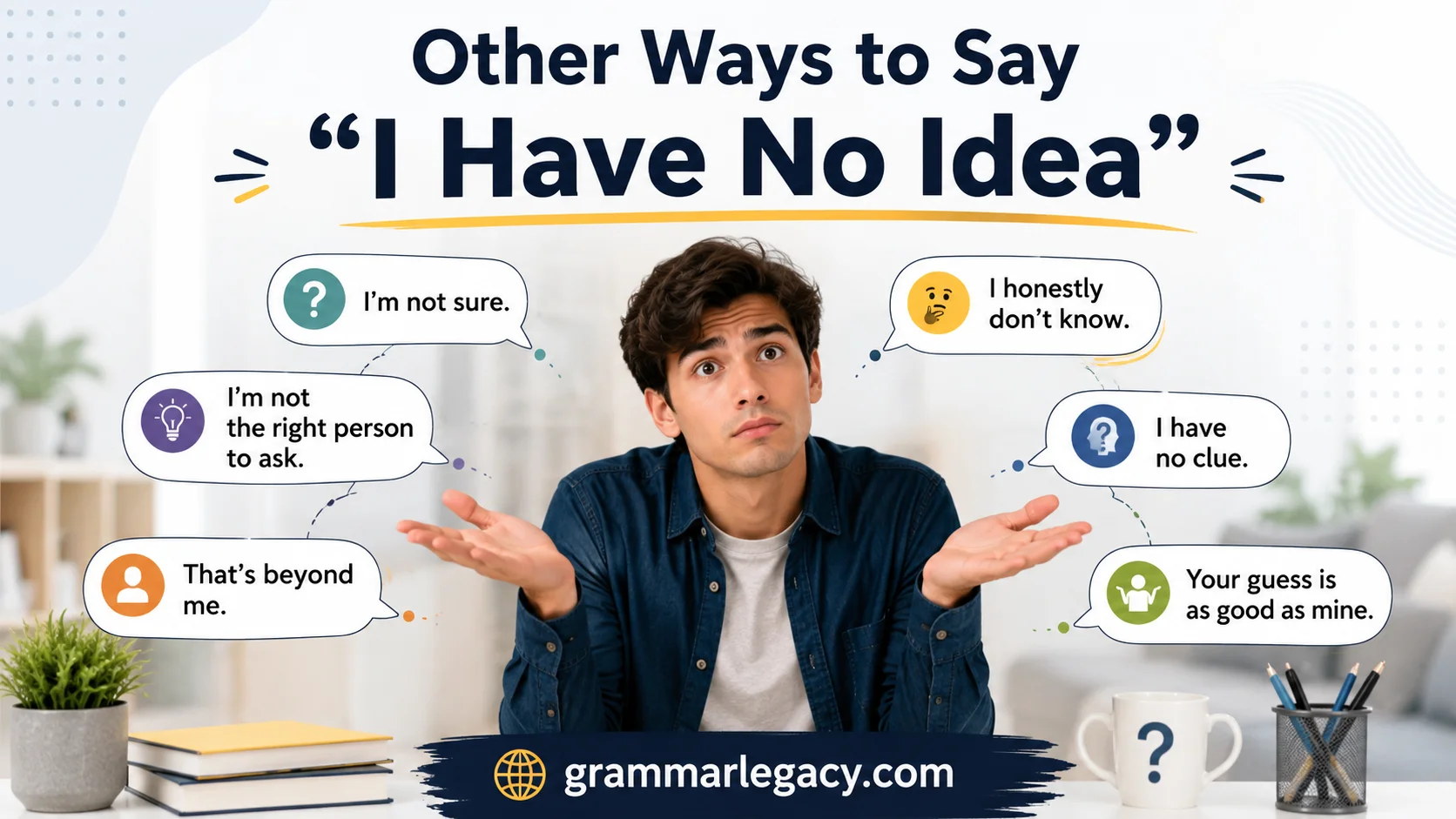

Other Ways to Say “I Have No Idea” (With Examples) is a helpful guide for expressing uncertainty in a polite and natural way. Instead of repeating the same phrase, you can choose professional, casual, or friendly alternatives that fit different situations. Using the right words improves communication, makes your message clearer, and helps others understand your thoughts without sounding rude or unsure.
Whether you’re speaking at work, chatting with friends, or writing an email, choosing the right expression makes a big difference. Phrases like “I’m not sure,” “I’m not aware,” or “Your guess is as good as mine” sound more thoughtful, respectful, and expressive. These alternatives build better connections, improve clarity, and help you communicate with confidence in both formal and everyday conversations.
Did You Know About Other Ways to Say “I Have No Idea”?
Many English speakers use “I have no idea” so often that they do not realize how flexible the language can be. A simple change in wording can make you sound softer, smarter, more diplomatic, or more helpful. For example, “I’m not sure” sounds gentler than “I have no idea,” while “I can’t confirm that” sounds more formal and careful.
Another interesting fact is that people often use this phrase not only to show a lack of knowledge, but also to avoid sounding too direct. In business, politics, customer service, and public communication, a more polished alternative can protect tone and maintain trust.
What Does “I Have No Idea” Mean?
“I have no idea” means that a person does not know the answer, does not understand something, or has no information about a topic. It is usually used when someone is asked a question and cannot provide useful details.
The phrase can express confusion, uncertainty, ignorance, or a complete lack of information. In casual speech, it is perfectly normal. In formal writing or professional communication, however, it may be better to use a more measured alternative such as “I’m not sure” or “I don’t have that information.”
Professional or Polite Ways to Say “I Have No Idea”
In professional or public-facing communication, it is usually better to sound calm, respectful, and solution-focused. Instead of saying “I have no idea,” you can use phrases like “I don’t have that information,” “I can’t confirm that,” or “I’ll need to check.” These expressions sound more polished and help you stay credible.
In political, executive, or customer service settings, the best wording is often the one that shows honesty without sounding careless. A professional alternative should communicate uncertainty while keeping the conversation productive.
“I Have No Idea” Synonyms
- I’m Not Sure
- I Don’t Know
- I Haven’t the Faintest Idea
- Your Guess Is as Good as Mine
- I Couldn’t Tell You
- I Wish I Knew
- I’m Clueless
- I Haven’t Got a Clue
- Beats Me
- That’s Beyond Me
- I’m Unsure
- I Can’t Say for Certain
- I’m Not in the Loop
- I Don’t Have That Information
- I’m Afraid I Don’t Know
- I Can’t Help You There
- I Don’t Have the Answer
- I Haven’t Heard Anything
- That’s a Good Question
- I’m Not Familiar with That
- I Don’t Have Enough Information
- I Can’t Confirm That
- I Haven’t Looked Into It
- I Couldn’t Guess
- I Have No Information on That
- Search Me
- That’s News to Me
- I Can’t Be Certain
- I’m Drawing a Blank
- I Honestly Don’t Know
1. I’m Not Sure
Definition: This phrase shows uncertainty without sounding too strong or too blunt. It is one of the safest and most natural alternatives in both speech and writing.
Meanings: Uncertain, not fully confident, unable to confirm.
Example: “I’m not sure what time the meeting starts.”
Detailed Explanation: I’m not sure is a soft and polite way to say you do not know something completely. It is less direct than “I have no idea,” so it often sounds more respectful. People use it in work conversations, school discussions, and everyday chats. It also gives the speaker room to continue the conversation without sounding closed off.
Tone: Neutral, polite, careful.
Best use: Use it when you want to sound honest but not too blunt.
2. I Don’t Know
Definition: This is the simplest and most direct way to say you do not know something. It is extremely common in casual and everyday English.
Meanings: Lack of knowledge, no answer, not aware.
Example: “I don’t know where she left the keys.”
Detailed Explanation: I don’t know is shorter and more direct than I have no idea. It can work well in casual speech, but it may sound a little plain in formal settings. Because it is so common, it is easy for listeners to understand immediately. If you want to keep things simple and clear, this phrase works very well.
Tone: Direct, simple, neutral.
Best use: Use it in everyday conversation when clarity matters most.
3. I Haven’t the Faintest Idea
Definition: This phrase is a stronger and more expressive way of saying you do not know anything. It is often used for emphasis.
Meanings: Complete lack of knowledge, total uncertainty.
Example: “I haven’t the faintest idea how that happened.”
Detailed Explanation: This expression sounds a little more dramatic and old-fashioned than I have no idea. It can be useful when you want to emphasize how completely unaware you are. The phrase is less common in modern casual speech, but it still appears in writing and polite conversation. It can add style, especially if you want a more literary or expressive tone.
Tone: Emphatic, formal, slightly old-fashioned.
Best use: Use it when you want to sound expressive or dramatic.
4. Your Guess Is as Good as Mine
Definition: This phrase means that neither person knows the answer. It shifts the uncertainty into a shared space.
Meanings: I do not know, you do not know either, equal uncertainty.
Example: “Why the system crashed? Your guess is as good as mine.”
Detailed Explanation: This is a very common conversational phrase that feels relaxed and natural. It works especially well when the answer is unclear to everyone involved. The expression can also create a friendly sense of shared confusion. It is useful when you want to avoid sounding too serious or too dry.
Tone: Casual, friendly, conversational.
Best use: Use it when no one really knows the answer.
5. I Couldn’t Tell You
Definition: This phrase means that you are unable to provide the answer. It sounds slightly softer than a direct refusal.
Meanings: I do not know, I cannot provide that information.
Example: “I couldn’t tell you who approved the change.”
Detailed Explanation: I couldn’t tell you is often used when the speaker wants to sound polite and modest. It can feel more natural than a blunt I don’t know in some situations. The phrase is especially useful when you are unsure but do not want to sound careless. It also works well in customer-facing or workplace communication.
Tone: Polite, calm, restrained.
Best use: Use it when you want a gentle and respectful reply.
6. I Wish I Knew
Definition: This phrase expresses that you do not know something and would like to know it. It can also show frustration or curiosity.
Meanings: I do not know, I want the answer, I am curious.
Example: “I wish I knew why she decided to leave.”
Detailed Explanation: This phrase adds emotion to uncertainty. It shows that you are not just uninformed, but also interested in the answer. People often use it when they feel frustrated, confused, or curious. It is very natural in both casual and emotional conversations.
Tone: Thoughtful, emotional, slightly frustrated.
Best use: Use it when you genuinely wish you had the answer.
7. I’m Clueless
Definition: This is a casual way of saying you do not understand or know anything about the topic. It often sounds informal and playful.
Meanings: Completely uninformed, not aware, no clue.
Example: “I’m clueless about how to fix this printer.”
Detailed Explanation: I’m clueless can sound humorous, honest, and relaxed. It is commonly used with friends, family, or in informal situations. Because it is playful, it may not be the best choice in professional communication. Still, it is useful when you want to admit uncertainty in a lighthearted way.
Tone: Casual, playful, informal.
Best use: Use it with friends or in relaxed conversation.
8. I Haven’t Got a Clue
Definition: This phrase means you have absolutely no knowledge or answer. It is a strong informal expression.
Meanings: No idea, no answer, complete uncertainty.
Example: “I haven’t got a clue where he went.”
Detailed Explanation: This expression is common in British English and sounds conversational. It is stronger than I’m not sure and more expressive than I don’t know. The phrase suggests a total absence of information. It is useful in casual speech when you want to sound natural and direct.
Tone: Casual, emphatic, informal.
Best use: Use it in relaxed speech when you want stronger emphasis.
9. Beats Me
Definition: This is a very casual phrase that means you do not know. It is often used in informal conversation.
Meanings: I do not know, I cannot explain it, I am just as confused.
Example: “Why did they cancel the event? Beats me.”
Detailed Explanation: Beats me is short, simple, and extremely conversational. It often carries a tone of shrugging or mild frustration. Because it sounds informal, it is best used with people you know well. It can also add a friendly, slightly humorous effect.
Tone: Casual, relaxed, informal.
Best use: Use it in quick everyday conversations.
10. That’s Beyond Me
Definition: This phrase means something is too difficult or unfamiliar for you to explain. It suggests that the topic is outside your knowledge or ability.
Meanings: Too advanced, not within my knowledge, beyond my understanding.
Example: “How the software works? That’s beyond me.”
Detailed Explanation: This phrase is useful when the topic feels technical, complicated, or unfamiliar. It sounds modest and honest without being rude. The expression can also show that you are not the right person to ask. It works well when you want to admit limits politely.
Tone: Polite, modest, neutral.
Best use: Use it when the subject is too complex or specialized.
11. I’m Unsure
Definition: This is a calm and professional way to say you are not certain. It is often used in formal communication.
Meanings: Not certain, uncertain, not fully confident.
Example: “I’m unsure whether the report is ready yet.”
Detailed Explanation: I’m unsure sounds a little more polished than I don’t know. It is useful in writing, meetings, and professional settings. The phrase shows honesty while keeping a respectful tone. It can also help you avoid sounding too abrupt or dismissive.
Tone: Professional, careful, neutral.
Best use: Use it in work emails, meetings, and formal discussions.
12. I Can’t Say for Certain
Definition: This phrase means you are not confident enough to confirm something. It suggests caution and accuracy.
Meanings: I cannot verify, not completely sure, unable to confirm.
Example: “I can’t say for certain who sent the message.”
Detailed Explanation: This is a strong professional alternative when accuracy matters. It sounds more responsible than guessing or making assumptions. People use it in business, legal, and formal communication. It shows that you are careful with facts and not rushing to conclusions.
Tone: Formal, careful, responsible.
Best use: Use it when certainty is important.
13. I’m Not in the Loop
Definition: This phrase means you are not included in the current information or updates. It suggests that someone else may know more.
Meanings: Not informed, not updated, outside the information chain.
Example: “I’m not in the loop on that project.”
Detailed Explanation: This phrase is especially common in office and team settings. It tells people that your lack of knowledge comes from missing updates, not carelessness. It can be helpful when you want to explain why you cannot answer. The phrase sounds modern, natural, and slightly informal.
Tone: Professional, modern, conversational.
Best use: Use it when you have not been included in the latest updates.
14. I Don’t Have That Information
Definition: This is a professional and direct way to say you cannot provide the answer. It sounds more polished than I have no idea.
Meanings: I do not know, the information is unavailable to me.
Example: “I don’t have that information at the moment.”
Detailed Explanation: This phrase is very useful in customer service, office settings, and formal replies. It tells the listener that you are not ignoring the question, just lacking the data. It also keeps the tone respectful and neutral. If you want to sound responsible and clear, this is a strong choice.
Tone: Professional, neutral, polite.
Best use: Use it in business, service, and formal communication.
15. I’m Afraid I Don’t Know
Definition: This phrase is a polite way to admit that you do not know something. It often sounds considerate and formal.
Meanings: I do not know, sorry, unable to answer.
Example: “I’m afraid I don’t know the exact deadline.”
Detailed Explanation: The phrase softens the response and makes it sound more courteous. It is especially common in British-style formal English. The addition of “I’m afraid” helps the sentence feel less abrupt. It is a helpful choice when politeness is important.
Tone: Polite, formal, respectful.
Best use: Use it in formal conversations and written replies.
Read More: 30 Other Ways to Say “I Don’t Know” (With Examples)
16. I Can’t Help You There
Definition: This phrase means you are unable to answer or assist with the topic. It is a conversational way to show limits.
Meanings: I do not know, I cannot assist with that, not able to answer.
Example: “I can’t help you there, but maybe the admin team can.”
Detailed Explanation: This expression is helpful when you want to be honest but still kind. It often appears before offering another possible source of help. The phrase keeps the conversation moving instead of ending it sharply. It is practical for workplace and support situations.
Tone: Helpful, polite, conversational.
Best use: Use it when you want to decline while staying supportive.
17. I Don’t Have the Answer
Definition: This phrase directly states that you cannot provide the solution. It sounds clear and professional.
Meanings: No answer, no solution, not able to explain.
Example: “I don’t have the answer right now.”
Detailed Explanation: This is a straightforward and honest phrase. It is useful when you want to be clear without sounding rude. The wording suggests that the answer may exist, but you do not have it. It works well in both formal and neutral situations.
Tone: Clear, professional, neutral.
Best use: Use it when directness is needed.
18. I Haven’t Heard Anything
Definition: This phrase means you have not received any news or updates. It suggests a lack of recent information.
Meanings: No updates, no news, not informed.
Example: “I haven’t heard anything about the schedule change.”
Detailed Explanation: This is useful when the answer depends on recent communication. It tells the listener that your knowledge is limited by the information you have received. The phrase is friendly and honest without sounding too formal. It is especially useful in team or project-related discussions.
Tone: Neutral, conversational, informative.
Best use: Use it when you have not received any recent updates.
19. That’s a Good Question
Definition: This phrase shows that the question is thoughtful or difficult. It often buys time while you think.
Meanings: Interesting question, difficult question, not immediately sure.
Example: “That’s a good question, and I’m not sure yet.”
Detailed Explanation: This phrase is excellent when you need a moment to gather your thoughts. It can soften uncertainty and make the conversation feel more positive. Even if you do not know the answer, it shows respect for the question. It is common in interviews, meetings, and discussions.
Tone: Polite, thoughtful, diplomatic.
Best use: Use it when you want to respond gracefully to a difficult question.
20. I’m Not Familiar with That
Definition: This phrase means you do not know enough about the topic. It suggests a lack of experience rather than total confusion.
Meanings: Not knowledgeable about it, new to the topic, unfamiliar.
Example: “I’m not familiar with that process.”
Detailed Explanation: This is a refined and professional alternative to I have no idea. It sounds balanced and respectful, especially in work settings. The phrase implies that you may be able to learn more later. It is useful when you want to sound honest but not careless.
Tone: Professional, polite, neutral.
Best use: Use it when the topic is outside your area of knowledge.
21. I Don’t Have Enough Information
Definition: This phrase means you cannot answer properly because the facts are incomplete. It focuses on missing details rather than ignorance.
Meanings: Incomplete data, not enough facts, cannot judge yet.
Example: “I don’t have enough information to comment.”
Detailed Explanation: This is a strong phrase for professional and analytical settings. It shows that you are being careful rather than making assumptions. People often use it in reports, meetings, and decision-making conversations. It helps maintain credibility and accuracy.
Tone: Formal, thoughtful, precise.
Best use: Use it when a careful answer requires more facts.
22. I Can’t Confirm That
Definition: This phrase means you are not in a position to verify the information. It sounds professional and cautious.
Meanings: Unable to verify, cannot validate, not confirmed.
Example: “I can’t confirm that at this time.”
Detailed Explanation: This is especially useful in public, business, or official communication. It avoids making claims without evidence. The phrase sounds careful and responsible, which is important in sensitive situations. It is often better than guessing or speaking too confidently.
Tone: Formal, cautious, professional.
Best use: Use it when accuracy and verification matter.
23. I Haven’t Looked Into It
Definition: This phrase means you have not researched or checked the matter yet. It shows that the lack of answer is due to timing.
Meanings: Not researched, not checked, no investigation yet.
Example: “I haven’t looked into it yet.”
Detailed Explanation: This phrase is honest and practical. It tells the other person that you may still be able to find out later. It is useful when you want to show responsibility without pretending to know. The wording also suggests that action could follow.
Tone: Honest, practical, neutral.
Best use: Use it when you have not had time to investigate.
24. I Couldn’t Guess
Definition: This phrase means you do not want to speculate without facts. It is a careful way to avoid giving a random answer.
Meanings: Unable to estimate, not willing to speculate, no reliable guess.
Example: “I couldn’t guess how long it will take.”
Detailed Explanation: This phrase is useful when guessing would be unhelpful or inaccurate. It shows that you prefer to stay factual rather than careless. In formal situations, it can be a good way to avoid misleading others. It also communicates humility and restraint.
Tone: Careful, restrained, neutral.
Best use: Use it when you do not want to speculate.
25. I Have No Information on That
Definition: This phrase means you possess no data or details about the topic. It sounds formal and clear.
Meanings: No details, no data, no facts available.
Example: “I have no information on that matter.”
Detailed Explanation: This expression is especially useful in professional communication. It sounds more structured than I have no idea. The phrase is good when you need to stay polite and factual. It also makes it clear that the issue is about missing information, not unwillingness.
Tone: Formal, direct, professional.
Best use: Use it in business, official, or informational contexts.
26. Search Me
Definition: This is a casual phrase meaning you do not know the answer. It often sounds witty or slightly amused.
Meanings: I do not know, no clue, not my area.
Example: “Why he changed his mind? Search me.”
Detailed Explanation: This expression is informal and usually spoken, not written. It can sound playful or slightly dismissive depending on the tone. Because of its casual nature, it is best used with people you know well. It may not be suitable for professional or serious communication.
Tone: Casual, humorous, informal.
Best use: Use it in light everyday conversation.
27. That’s News to Me
Definition: This phrase means the information is new or surprising to you. It implies that you were not aware of it before.
Meanings: I did not know that, surprising information, new to me.
Example: “That’s news to me—I hadn’t heard about the change.”
Detailed Explanation: This phrase is useful when someone shares information you did not know. It can sound surprised, interested, or even skeptical depending on context. It is a polite way to say you were not informed. The expression works well in conversation, email, and informal work settings.
Tone: Surprised, conversational, neutral.
Best use: Use it when the information is unexpected or new to you.
28. I Can’t Be Certain
Definition: This phrase means you cannot give a guaranteed or definite answer. It shows caution and honesty.
Meanings: Not definite, not confirmed, unable to be sure.
Example: “I can’t be certain without checking the details.”
Detailed Explanation: This is a strong phrase for careful communication. It helps avoid false confidence and shows that you value accuracy. People use it in professional, academic, and formal settings. It is especially helpful when the answer depends on missing facts.
Tone: Formal, cautious, reliable.
Best use: Use it when you want to avoid giving a definite answer too soon.
29. I’m Drawing a Blank
Definition: This phrase means you cannot remember or think of the answer right now. It often describes a temporary mental block.
Meanings: Blank memory, nothing coming to mind, momentary forgetfulness.
Example: “I’m drawing a blank on his name.”
Detailed Explanation: This is a very natural phrase in casual English. It often suggests that the answer may come back later. The phrase can be used for names, facts, or ideas that temporarily escape you. It sounds honest and relatable in everyday conversation.
Tone: Casual, natural, slightly frustrated.
Best use: Use it when your memory is failing you temporarily.
30. I Honestly Don’t Know
Definition: This phrase adds emphasis to a simple admission of uncertainty. It feels sincere and direct.
Meanings: Truly unsure, no answer, being honest about uncertainty.
Example: “I honestly don’t know what happened after that.”
Detailed Explanation: This phrase is useful when you want to sound sincere and straightforward. The word “honestly” adds emotional weight and openness. It can make your answer feel more genuine and less robotic. It works well in both casual and semi-formal conversations.
Tone: Honest, sincere, direct.
Best use: Use it when you want to emphasize truthfulness.
FAQs :
1. What does “I Have No Idea” mean?
It means you do not know the answer or have no information about a particular topic or situation. It is a common expression used in everyday English.
2. What are some professional alternatives to “I Have No Idea”?
Professional alternatives include “I’m not sure,” “I’m not aware,” “I don’t have that information,” and “I’ll need to check on that.” These sound more polite in workplace communication.
3. Can I use “I Have No Idea” in formal writing?
While it is grammatically correct, it may sound too casual. In formal writing or business emails, it’s better to use more professional expressions.
4. Why should I learn other ways to say “I Have No Idea”?
Using different expressions improves your communication skills, avoids repetition, and helps you match the right tone for professional, academic, or casual conversations.
5. Which alternative is best for casual conversations?
Friendly options like “I haven’t got a clue,” “Beats me,” or “Your guess is as good as mine” work well when talking with friends or family.
Conclusion :
Learning Other Ways to Say “I Have No Idea” helps you communicate with greater confidence, clarity, and politeness. Whether you’re speaking in a professional meeting, writing an email, or chatting with friends, choosing the right expression makes your message sound more natural and engaging. By using these alternatives, you can avoid repetition, improve your English vocabulary, and express uncertainty in a way that fits every situation.