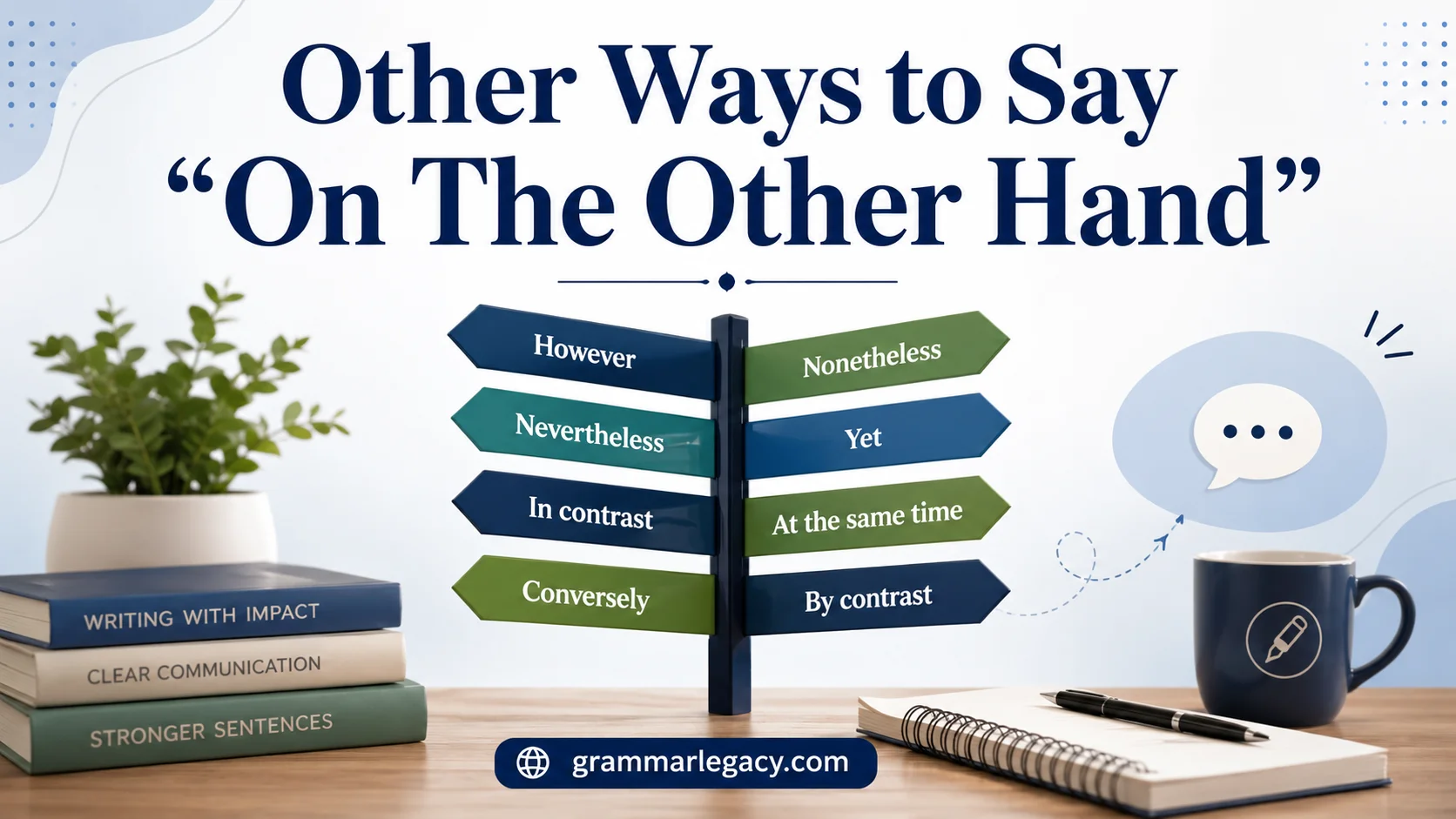

Other Ways to Say “On The Other Hand” (With Examples) is a helpful guide for anyone who wants to improve their writing and communication skills. While “on the other hand” is a common phrase for showing contrast, using it too often can make your sentences repetitive. Learning fresh and natural alternatives helps you create better flow, express different perspectives, and keep readers engaged in essays, emails, blogs, and everyday conversations.
Whether you need a formal, informal, casual, or creative expression, choosing the right transition can make your message clearer and more effective. This guide shares practical alternatives, easy examples, and useful tips to help you present balanced ideas with confidence. By expanding your vocabulary, you can write more naturally, improve clarity, and make every sentence sound polished and professional.
Did You Know About “On The Other Hand”?
On the other hand is not just a phrase for comparison. It is a powerful contrast signal that tells the reader or listener, “Now let’s look at the other side.” This makes it especially useful in academic writing, business communication, debate, and everyday conversation.
Did you know that many writers prefer to vary contrast words like however, nevertheless, by contrast, and conversely to improve flow? Using a variety of transition phrases also helps your writing sound more natural, intelligent, and less repetitive.
What Does “On The Other Hand” Mean?
On the other hand means in contrast, from a different angle, or looking at the opposite side of the situation. It is often used when you want to present another idea that may seem different, balanced, or slightly opposing.
For example, you might say: “The job pays well. On the other hand, the commute is very long.” In this sentence, the phrase shows that the second point gives a different perspective on the first point.
Professional or Political Way to Say “On The Other Hand”
In professional or political writing, people often prefer phrases that sound more measured, neutral, and diplomatic. Some of the best choices include however, conversely, that said, in contrast, from another perspective, and with that in mind.
These alternatives work well in reports, speeches, policy discussions, interviews, official statements, and formal arguments. They allow you to disagree gently, present another side, or shift the reader’s focus without sounding too direct or emotional.
“On The Other Hand” Synonyms
1. However
2. On the Flip Side
3. In Contrast
4. Conversely
5. That Said
6. Nevertheless
7. Even So
8. Yet
9. On the Contrary
10. By Contrast
11. On the Other Side
12. At the Same Time
13. Still
14. Though
15. Although
16. Even Though
17. Yet Still
18. Nonetheless
19. Instead
20. Alternatively
21. In Another Respect
22. From Another Perspective
23. On the Whole
24. That Being Said
25. In Comparison
26. In a Different Respect
27. From a Different Angle
28. On a Different Note
29. Looking at It Another Way
30. From the Opposite Perspective
1. However
Definition: However is a formal contrast word used to introduce an opposing or limiting idea. It is one of the most common and flexible alternatives to on the other hand.
Meanings: Still, yet, but, nevertheless.
Example: The team worked hard; however, the results were disappointing.
Detailed Explanation: However is ideal when you want to show contrast in a clean and professional way. It works in essays, reports, emails, and speeches because it sounds natural and polished. Unlike some other phrases, it does not feel too dramatic or conversational. It is simple, direct, and widely accepted in academic and business writing. If you want a phrase that always feels safe and correct, however is one of the best choices.
Tone: Formal, neutral, professional.
Best use: Academic writing, business writing, formal conversation.
2. On the flip side
Definition: On the flip side is a casual phrase used to show another side of an idea. It often feels more relaxed and conversational than on the other hand.
Meanings: In contrast, from another angle, looking at the other side.
Example: The apartment is small. On the flip side, it is very affordable.
Detailed Explanation: This phrase works well in everyday speech, blogs, and friendly writing. It gives your sentence a more modern and easygoing feel. Because it is informal, it is not the best choice for academic papers or official documents, but it is excellent for social media, casual articles, and spoken English. It helps you sound natural while still showing contrast clearly.
Tone: Casual, modern, conversational.
Best use: Daily conversation, blogs, informal writing.
3. In contrast
Definition: In contrast is a direct phrase used to compare two different ideas or situations. It clearly shows difference between two points.
Meanings: Oppositely, differently, as compared with.
Example: The first plan is expensive. In contrast, the second plan is budget-friendly.
Detailed Explanation: This phrase is especially useful in writing because it creates a clear connection between two ideas. It is often used in essays, reports, and analysis where comparison matters. In contrast sounds balanced and objective, which makes it useful in both formal and semi-formal contexts. It is a strong alternative when you want clarity without too much emotional tone.
Tone: Neutral, formal, analytical.
Best use: Comparisons, reports, academic writing.
4. Conversely
Definition: Conversely is a formal word used to introduce the opposite idea or situation. It is often used in structured writing and careful argumentation.
Meanings: On the other hand, oppositely, reversing the point.
Example: Some people prefer teamwork; conversely, others work better alone.
Detailed Explanation: This phrase is elegant and precise, especially in formal writing. It is often used when you want to show a direct opposite without sounding casual. It can make your writing sound intelligent and sophisticated. However, it should be used carefully because it can feel slightly academic or technical in everyday speech. It is best when you want a refined and logical contrast.
Tone: Formal, intellectual, polished.
Best use: Essays, reports, research, formal analysis.
5. That said
Definition: That said is a transitional phrase used to soften a contrast or add a balancing thought. It often sounds thoughtful and natural.
Meanings: Even so, still, despite that.
Example: The restaurant is crowded. That said, the food is worth the wait.
Detailed Explanation: This phrase is excellent when you want to sound polite and balanced. It does not sound too harsh, so it works well in professional conversations, blog writing, and presentations. That said is useful when you want to acknowledge one point before shifting to another. It keeps your writing smooth and human while still making a contrast clear.
Tone: Thoughtful, balanced, professional.
Best use: Business writing, reviews, friendly formal writing.
6. Nevertheless
Definition: Nevertheless is a formal contrast word that means something is true despite the previous point. It often strengthens the meaning of the sentence.
Meanings: Still, even so, regardless.
Example: It was raining heavily; nevertheless, they went for a walk.
Detailed Explanation: This phrase is often used when the second idea feels surprising or stronger than expected. It gives your writing a serious and polished tone. In essays or formal writing, nevertheless helps you show resilience, contrast, or persistence. It is a powerful option when you want to emphasize that something happened despite a challenge or limitation.
Tone: Formal, serious, strong.
Best use: Academic writing, speeches, formal arguments.
7. Even so
Definition: Even so is a simple phrase used to show that the next idea still stands despite the first one. It is easier and softer than many formal contrast words.
Meanings: Still, nevertheless, all the same.
Example: The task was difficult. Even so, she completed it on time.
Detailed Explanation: This phrase sounds natural in both spoken and written English. It is less formal than nevertheless but still clear and effective. It works well when you want to show balance without sounding stiff. Even so is a nice choice for everyday writing because it feels warm, readable, and smooth.
Tone: Neutral, calm, conversational.
Best use: General writing, conversation, storytelling.
8. Yet
Definition: Yet is a short contrast word that introduces an unexpected or opposite idea. It is simple but powerful.
Meanings: But, still, even so.
Example: He is young, yet very wise.
Detailed Explanation: Because it is short, yet is very easy to use in both speaking and writing. It gives sentences a natural rhythm and helps you avoid overusing longer transition phrases. It is especially effective in concise writing where you want a quick contrast. Despite being short, it can carry a lot of meaning and keep your sentence elegant.
Tone: Neutral, smooth, flexible.
Best use: Everyday writing, essays, storytelling.
9. On the contrary
Definition: On the contrary is used to directly oppose a statement or assumption. It strongly disagrees with what was said before.
Meanings: Oppositely, not at all, rather the reverse.
Example: I thought the event would be boring. On the contrary, it was exciting.
Detailed Explanation: This phrase is stronger than many other contrast words. It is useful when you want to correct a misunderstanding or reject a previous idea. It can sound confident, clear, and authoritative. In formal writing, it helps sharpen your response. In speech, it may sound a little emphatic, so it should be used when you want a stronger reaction.
Tone: Direct, strong, confident.
Best use: Debate, correction, formal disagreement.
10. By contrast
Definition: By contrast is used to show a clear difference between two things. It often appears in comparison-based writing.
Meanings: In comparison, differently, as opposed to.
Example: The city is crowded; by contrast, the village is peaceful.
Detailed Explanation: This phrase is especially useful when you are comparing two people, places, ideas, or situations. It sounds structured and polished, which makes it ideal for reports, essays, and analytical writing. By contrast helps the reader see difference immediately. It is one of the cleanest and most effective formal alternatives to on the other hand.
Tone: Formal, clear, analytical.
Best use: Comparison writing, reports, academic content.
11. On the other side
Definition: On the other side is a simple phrase used to present another viewpoint or condition. It feels more literal and conversational.
Meanings: From another angle, in another respect.
Example: The house is beautiful. On the other side, it needs a lot of repairs.
Detailed Explanation: This phrase is easy to understand and works well in casual or descriptive writing. It is not as formal as however or nevertheless, but it still creates a nice balance. You can use it when you want to sound natural and reflective. It gives the impression that you are considering both sides before making a decision or judgment.
Tone: Casual, balanced, thoughtful.
Best use: Conversation, blogs, simple explanations.
12. At the same time
Definition: At the same time is used to show a second idea that exists alongside the first. It can introduce contrast or balance.
Meanings: Simultaneously, also, in balance.
Example: The job is demanding. At the same time, it is very rewarding.
Detailed Explanation: This phrase is useful when two ideas are true together, even if they seem different. It helps create a more layered and realistic sentence. Writers often use it to show nuance rather than complete opposition. It sounds thoughtful and modern, and it works well in reflective writing, business communication, and everyday conversation.
Tone: Balanced, thoughtful, natural.
Best use: Reflective writing, business speech, daily English.
13. Still
Definition: Still is a short and flexible word that shows contrast or continuation. It often means “despite that.”
Meanings: Nevertheless, even so, anyway.
Example: The weather was bad. Still, they decided to go.
Detailed Explanation: This is one of the easiest contrast words to use in English. It sounds casual but remains clear and effective. Because it is short, it fits naturally into spoken English and simple writing. Still is useful when you want a smooth transition without sounding overly formal. It is especially helpful in storytelling and everyday conversation.
Tone: Natural, casual, simple.
Best use: Conversation, creative writing, informal posts.
14. Though
Definition: Though is a flexible word used to show contrast or exception. It can appear at the beginning, middle, or end of a sentence.
Meanings: However, even though, but.
Example: The movie was long. It was enjoyable, though.
Detailed Explanation: Though is widely used in both speech and writing because it feels natural and light. It can make your sentence sound more conversational than however. Writers often use it when they want to soften a contrast. It is simple, versatile, and very common in modern English, especially in casual dialogue.
Tone: Casual, natural, flexible.
Best use: Everyday speech, informal writing, friendly tone.
15. Although
Definition: Although introduces a contrast inside the same sentence. It shows that one idea is true even though another is different.
Meanings: Even though, despite the fact that.
Example: Although it was late, she kept studying.
Detailed Explanation: This phrase is very useful in writing because it creates smooth sentence structure. It is especially good for essays and formal writing where you want to connect ideas neatly. Although helps you sound precise and organized. It shows contrast without needing a separate sentence, which makes writing flow better.
Tone: Formal, smooth, structured.
Best use: Academic writing, essays, professional communication.
Read More: 30 Other Ways to Say “Even Though” (With Examples)
16. Even though
Definition: Even though is used to highlight a contrast that feels strong or surprising. It adds emphasis to the sentence.
Meanings: Although, despite the fact that.
Example: Even though he was tired, he finished the project.
Detailed Explanation: This phrase is slightly stronger than although because it gives more emotional weight to the contrast. It is helpful when you want to show determination, persistence, or difficulty. It sounds natural in both writing and speech. It is a great choice when you want your contrast to feel more vivid and human.
Tone: Emphatic, natural, clear.
Best use: Storytelling, essays, everyday writing.
17. Yet still
Definition: Yet still is used to emphasize that something continues despite contrast. It adds a gentle but noticeable shift.
Meanings: Nevertheless, even so, still.
Example: The road was dangerous, yet still they continued.
Detailed Explanation: This phrase gives your writing a slightly more dramatic or literary feel. It works well in narrative writing, emotional speech, and reflective essays. Because it combines two contrast ideas, it feels stronger than a single short transition. It can help your writing sound more expressive and memorable.
Tone: Expressive, thoughtful, slightly dramatic.
Best use: Storytelling, speeches, reflective writing.
18. Nonetheless
Definition: Nonetheless is a formal word meaning “in spite of that.” It is similar to nevertheless.
Meanings: Still, however, regardless.
Example: The challenge was difficult; nonetheless, the team succeeded.
Detailed Explanation: This word sounds polished and serious, making it a strong choice for formal writing. It is often used in essays, reports, and speeches where the writer wants to sound professional. Nonetheless helps show perseverance or logical contrast without sounding emotional. It is especially useful when you want a sophisticated, balanced tone.
Tone: Formal, polished, serious.
Best use: Reports, academic writing, formal speeches.
19. Instead
Definition: Instead shows substitution or an alternative choice. It can also introduce a contrast in action.
Meanings: As an alternative, in place of that, rather.
Example: We planned to eat out; instead, we cooked at home.
Detailed Explanation: This word is ideal when the second idea replaces the first one. It is not exactly the same as on the other hand, but it works well when you want to show another option or outcome. It sounds natural in both speaking and writing. Instead is useful for making your point feel practical and direct.
Tone: Natural, practical, clear.
Best use: Everyday English, decision-making, explanations.
20. Alternatively
Definition: Alternatively introduces another possible choice or version. It is often used in formal and practical writing.
Meanings: As another option, on the other hand, or else.
Example: You can take the train; alternatively, you can drive.
Detailed Explanation: This phrase is especially helpful when listing options or suggesting a backup plan. It sounds professional and organized, making it useful in business writing, instructions, and academic discussion. Unlike stronger contrast words, it does not create conflict. Instead, it presents a different possibility in a calm and logical way.
Tone: Formal, logical, professional.
Best use: Instructions, business writing, option-based discussion.
21. In another respect
Definition: In another respect is used to show a different angle or point of view. It sounds thoughtful and analytical.
Meanings: From another perspective, in a different way.
Example: The plan is expensive. In another respect, it may save time.
Detailed Explanation: This phrase is very useful when you want to move from one aspect of a topic to another. It is not as common as however, but it adds variety and sophistication to your writing. It works best in formal analysis, essays, and reports. It helps you show depth by examining more than one side of an issue.
Tone: Formal, reflective, analytical.
Best use: Essays, reports, balanced arguments.
22. From another perspective
Definition: From another perspective means looking at the issue in a different way. It is ideal for balanced or thoughtful writing.
Meanings: From a different viewpoint, on the other hand.
Example: From another perspective, the decision makes sense.
Detailed Explanation: This phrase is excellent when you want to show empathy, fairness, or open-mindedness. It helps readers understand that there is more than one valid way to see something. It is common in essays, discussions, and professional conversations. Because it sounds respectful and thoughtful, it is especially useful in sensitive or controversial topics.
Tone: Balanced, respectful, thoughtful.
Best use: Discussion, opinion writing, diplomatic speech.
23. On the whole
Definition: On the whole is used to express an overall judgment after considering different sides. It can soften contrast and balance discussion.
Meanings: Overall, generally, in summary.
Example: The event had a few issues; on the whole, it was a success.
Detailed Explanation: This phrase is useful when you want to step back and give a general conclusion. It does not create strong opposition like however, but it still helps balance your statement. It is especially helpful in reports, reviews, and evaluations. It makes your writing sound measured and fair.
Tone: Neutral, balanced, thoughtful.
Best use: Summaries, reviews, evaluations.
24. That being said
Definition: That being said is a polite phrase used to introduce a contrasting point. It feels smoother and more conversational than many formal alternatives.
Meanings: However, even so, still.
Example: The product is expensive. That being said, it is high quality.
Detailed Explanation: This phrase is very popular in modern writing because it feels natural and polished at the same time. It works well in blogs, presentations, and professional messages. It allows you to shift gently from one point to another without sounding abrupt. It is a strong choice when you want a calm, respectful transition.
Tone: Polite, modern, balanced.
Best use: Business writing, blogs, presentations.
25. Yet on the other side
Definition: Yet on the other side is used to show a contrasting viewpoint or condition. It combines contrast with a sense of balance.
Meanings: However, in contrast, from the opposite side.
Example: The plan is risky; yet on the other side, it could be highly rewarding.
Detailed Explanation: This phrase feels a little more expressive than standard formal transitions. It works best in writing where you want to sound reflective or nuanced. It is not as common as however, but it can make your sentence stand out. Use it when you want to present tension between two ideas in a smooth, thoughtful way.
Tone: Reflective, balanced, slightly literary.
Best use: Essay writing, reflective articles, speeches.
26. At the same time, though
Definition: At the same time, though is a conversational phrase used to balance ideas. It softens contrast while keeping the sentence natural.
Meanings: Still, however, even so.
Example: I like the design. At the same time, though, it feels too busy.
Detailed Explanation: This phrase is common in speech and casual writing. It helps you sound relaxed while still making a clear contrast. Because it includes though, it feels friendly and human. It is useful in discussions where you want to be honest without sounding harsh. It is also a good way to show mixed feelings.
Tone: Casual, honest, balanced.
Best use: Conversation, reviews, informal writing.
27. In a different light
Definition: In a different light means viewing something from another angle. It is often used when reinterpreting an idea or situation.
Meanings: From another perspective, differently, alternatively.
Example: Seen in a different light, the mistake became a lesson.
Detailed Explanation: This phrase adds a thoughtful and slightly creative touch to your writing. It is especially effective in reflective essays, speeches, and personal writing. It suggests that understanding changes depending on viewpoint. That makes it useful when discussing growth, learning, or emotional insight. It sounds elegant and meaningful.
Tone: Reflective, poetic, thoughtful.
Best use: Essays, speeches, personal reflections.
28. On a different note
Definition: On a different note is used to shift to another idea or topic. It can also introduce a mild contrast.
Meanings: Changing the subject, speaking differently, in another direction.
Example: The meeting went well. On a different note, we still need to fix the budget issue.
Detailed Explanation: This phrase is very common in modern conversation and writing. It helps you move away from one subject and begin another without sounding abrupt. Although it is not a direct opposite phrase, it can function as a practical alternative in many contexts. It is especially useful in emails, chats, and blog writing.
Tone: Casual, smooth, modern.
Best use: Emails, blogs, conversation, topic shifts.
29. Looking at it another way
Definition: Looking at it another way introduces a new viewpoint or interpretation. It is useful for balanced and thoughtful communication.
Meanings: From another perspective, alternatively, on the other hand.
Example: The delay was frustrating. Looking at it another way, it gave us time to prepare.
Detailed Explanation: This phrase works well when you want to sound reflective, fair, and considerate. It is excellent for discussions that need depth or nuance. Because it invites the reader to reconsider the situation, it feels thoughtful and engaging. It can be used in casual speech, persuasive writing, and even professional communication.
Tone: Thoughtful, balanced, flexible.
Best use: Reflections, discussions, balanced opinions.
30. From the opposite angle
Definition: From the opposite angle is a phrase used to present the reverse side of an issue. It strongly suggests contrast or reconsideration.
Meanings: Oppositely, in contrast, from another viewpoint.
Example: The rule seems strict. From the opposite angle, it may actually protect fairness.
Detailed Explanation: This phrase is useful when you want to show that the same issue can be understood differently. It sounds descriptive and intelligent, which makes it effective in writing and discussion. It is not as common as however, but it adds variety and style. It works especially well when you want to show depth, balance, or critical thinking.
Tone: Reflective, analytical, formal.
Best use: Essays, speeches, opinion writing.
FAQs :
1. What does “on the other hand” mean?
“On the other hand” is a transition phrase used to introduce a contrasting idea, opinion, or perspective. It helps compare two different points in a clear and organized way.
2. What are some good alternatives to “on the other hand”?
Some popular alternatives include however, in contrast, conversely, alternatively, by comparison, then again, and having said that. The best choice depends on your tone and context.
3. Can I use these alternatives in formal writing?
Yes. Many alternatives, such as however, in contrast, conversely, and nevertheless, are suitable for academic papers, business emails, and professional documents.
4. Why should I avoid repeating “on the other hand”?
Using the same transition repeatedly can make your writing sound repetitive. Mixing in different expressions improves clarity, flow, and keeps your writing more engaging.
5. How do I choose the right alternative?
Consider your audience, writing style, and the strength of the contrast you want to express. Formal situations usually require more professional transitions, while casual conversations allow simpler and friendlier alternatives.
Conclusion :
Using other ways to say “On The Other Hand” can make your writing more natural, engaging, and effective. Whether you’re writing an essay, email, blog post, or having a conversation, choosing the right transition helps present contrasting ideas with greater clarity, flow, and confidence. By expanding your vocabulary and using these alternatives appropriately, you can communicate your thoughts more smoothly while keeping your writing fresh, polished, and easy to understand.