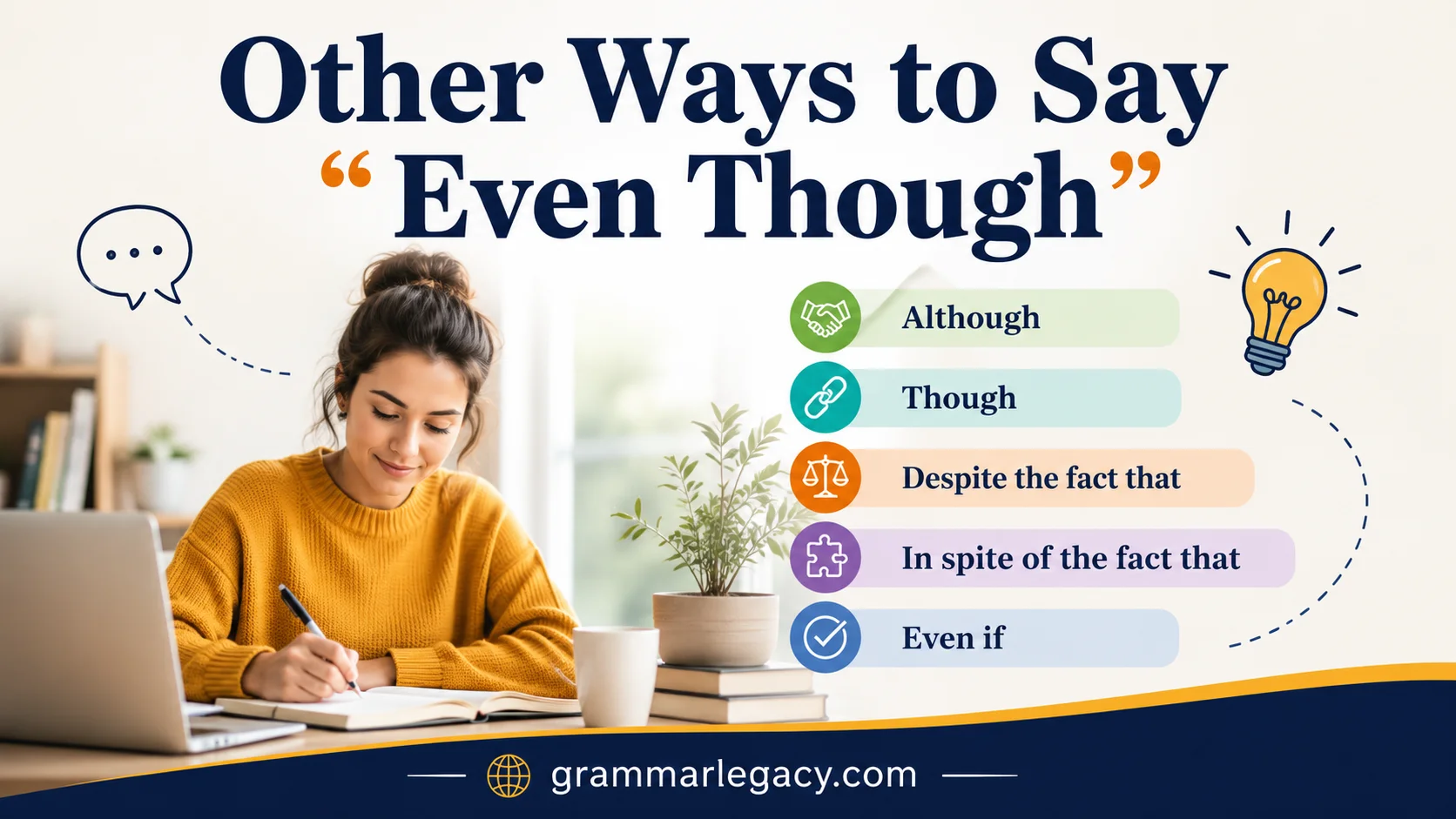

Other Ways to Say “Even Though” (With Examples) is a helpful guide for anyone who wants to improve their writing with more variety, clarity, and natural expression. Repeating the same phrase too often can make your sentences feel predictable, but learning fresh alternatives helps you express contrast more effectively. Whether you are writing essays, emails, or everyday messages, using the right expression makes your writing more engaging, polished, and easier for readers to understand.
Exploring different even though synonyms allows you to match the right tone, meaning, and context in every situation. Some alternatives sound more formal, while others fit casual conversations better. With practical examples and clear explanations, this guide will help you communicate with greater confidence, precision, and flexibility, making every sentence more expressive, professional, and enjoyable to read.
Did You Know About “Even Though”?
Even though is one of the most useful contrast expressions in English. It helps connect two ideas that seem opposite, such as success despite difficulty, happiness despite pain, or action despite warning. That is why it appears so often in academic writing, everyday speech, professional communication, and storytelling.
Many writers use even though without realizing that English offers many richer options. Some alternatives are softer, such as although and while, while others are stronger and more emphatic, such as despite the fact that or notwithstanding. Choosing the right phrase can improve clarity, tone, and style.
What Does “Even Though” Mean?
Even though means despite the fact that or although something is true. It introduces a contrast between two ideas.
For example, in the sentence “Even though it was raining, we went outside,” the rain did not stop the action. The phrase shows that the second part of the sentence happened in spite of the first part.
Professional or Political Ways to Say “Even Though”
In formal, business, academic, or political writing, you may want expressions that sound balanced, respectful, and precise. Some strong choices include although, despite the fact that, notwithstanding, regardless of the fact that, and in spite of the fact that.
These expressions are useful when you want to sound measured and professional rather than emotional or casual. For speeches, reports, policy writing, and official statements, they often fit better than informal alternatives.
“Even Though” Synonyms
1. Although
2. Though
3. Even If
4. In Spite of the Fact That
5. Despite the Fact That
6. Despite
7. In Spite of
8. Notwithstanding
9. While
10. Whereas
11. Albeit
12. Nonetheless
13. Nevertheless
14. Yet
15. Still
16. Though It May Be
17. Granted
18. Admittedly
19. Though Admittedly
20. Regardless
21. Regardless of the Fact That
22. At the Same Time
23. On the Other Hand
24. Yet Still
25. Though It Was True
26. Although Admittedly
27. Even So
28. In Any Case
29. However
30. Be That as It May
1. Although
Definition: Although is a formal and common word used to show contrast between two ideas. It is one of the cleanest and most natural alternatives to even though.
Meanings: It means despite the fact that or in spite of the fact that.
Example: Although it was late, she kept working.
Detailed Explanation: This phrase is widely used in both speaking and writing because it sounds smooth and natural. It creates a gentle contrast without sounding too heavy or dramatic. Writers often choose although when they want their sentence to remain clear, balanced, and professional. It works well in essays, reports, articles, and daily conversation. It is also useful when the contrast is important but not emotionally intense.
Tone: Formal, neutral, and polished.
Best use: Academic writing, professional communication, and general conversation.
2. Though
Definition: Though is a shorter and more conversational version of although. It is often used at the beginning, middle, or end of a sentence.
Meanings: It means despite that or however.
Example: The weather was cold; we went swimming, though.
Detailed Explanation: This word is flexible and easy to use in everyday English. It can sound casual, thoughtful, or slightly reflective depending on the sentence. Many native speakers use though in speech because it feels natural and relaxed. It is especially useful when you want a sentence to sound less formal and more human. It also works well when placed at the end of a sentence for emphasis.
Tone: Casual and conversational.
Best use: Daily conversation, messages, blogs, and informal writing.
3. Even if
Definition: Even if introduces a condition that may or may not happen. It is similar to even though, but it often refers to imagined or possible situations.
Meanings: It means in spite of the possibility that.
Example: Even if it rains, we will still go.
Detailed Explanation: This phrase is useful when speaking about plans, promises, or determination. It does not always describe a real fact; instead, it often points to a possible challenge. That makes it different from even though, which usually refers to something true already. Writers use even if to show confidence, resilience, or commitment. It is especially common in motivational, persuasive, and future-focused writing.
Tone: Determined, practical, and slightly formal.
Best use: Plans, promises, future situations, and persuasive writing.
4. In spite of the fact that
Definition: This is a formal phrase that clearly shows contrast. It is longer than even though, but it is very precise.
Meanings: It means despite the fact that or although.
Example: In spite of the fact that he was tired, he finished the project.
Detailed Explanation: This expression is strong, formal, and often used when clarity matters more than brevity. It can sound slightly heavy in casual speech, but it works very well in academic and legal-style writing. Because it includes the phrase the fact that, it often feels more deliberate and complete. Writers use it when they want to emphasize the contrast in a careful and structured way. It is not the shortest option, but it is one of the most explicit.
Tone: Formal and emphatic.
Best use: Reports, essays, official writing, and formal speech.
5. Despite the fact that
Definition: Despite the fact that is a formal phrase used to express contrast. It is closely related to even though.
Meanings: It means although or in spite of the fact that.
Example: Despite the fact that she was nervous, she gave a great presentation.
Detailed Explanation: This phrase is useful when you want to sound careful and professional. It is common in writing that values accuracy, such as journalism, academic papers, and formal articles. While it is a bit longer than although, it creates a strong and clear contrast. It works especially well when the second idea is surprising or impressive. It can also help make your sentence feel more complete and detailed.
Tone: Formal, clear, and professional.
Best use: Business writing, academic writing, and formal explanations.
6. Despite
Definition: Despite is a preposition used to show contrast. It is short, strong, and highly useful.
Meanings: It means in spite of.
Example: Despite the rain, the match continued.
Detailed Explanation: This word is powerful because it saves space while still expressing contrast clearly. It is often followed by a noun or noun phrase, which makes it different from phrases like although that introduce full clauses. Despite is common in formal writing, headlines, and spoken English. It gives a sentence a clean, efficient structure. Writers often prefer it when they want their message to feel strong and direct.
Tone: Neutral, formal, and concise.
Best use: Headlines, reports, and concise writing.
7. In spite of
Definition: In spite of is a prepositional phrase that shows contrast. It is one of the most familiar alternatives to even though.
Meanings: It means despite or regardless of.
Example: In spite of his fear, he spoke in public.
Detailed Explanation: This phrase is useful when you want to show that something happened even with an obstacle in place. It is slightly more expressive than despite and often feels natural in both speech and writing. It is especially effective when the contrast involves emotion, challenge, or effort. Many people use it when describing determination or persistence. It is simple, classic, and easy to understand.
Tone: Natural, moderate, and readable.
Best use: General writing, storytelling, and everyday communication.
8. Notwithstanding
Definition: Notwithstanding is a formal word meaning despite. It often appears in legal, official, or academic contexts.
Meanings: It means in spite of or despite that.
Example: Notwithstanding the objections, the plan moved forward.
Detailed Explanation: This is a sophisticated word that can make writing sound highly formal or authoritative. It is less common in casual conversation, but it remains useful in official documents and policy language. Because of its polished style, it can give your writing a serious and professional tone. However, it should be used carefully because it may sound overly stiff in everyday speech. It is best when precision and authority are important.
Tone: Very formal and authoritative.
Best use: Legal writing, official statements, and professional documents.
9. While
Definition: While can be used to show contrast between two ideas. It is also common for comparing two things at the same time.
Meanings: It means although in contrastive use.
Example: While she agreed with the idea, she had some concerns.
Detailed Explanation: This word is especially useful because it is short, smooth, and flexible. In contrastive sentences, it shows that two ideas exist together even though they differ. It works well in both formal and informal writing, depending on context. Because it is so common, it often sounds very natural to readers. Writers use it when they want contrast without making the sentence feel too heavy.
Tone: Balanced, natural, and versatile.
Best use: Essays, articles, conversations, and comparisons.
10. Whereas
Definition: Whereas is a formal linking word used to compare or contrast two ideas. It is often found in written English.
Meanings: It means in contrast or while on the other hand.
Example: She prefers tea, whereas her brother prefers coffee.
Detailed Explanation: This word is especially useful when comparing two different facts, habits, or opinions. It creates a clear contrast between two parts of a sentence. In formal writing, it helps the reader see the difference quickly and cleanly. It is common in academic, legal, and analytical writing. Because it sounds structured, it is best used when the contrast is central to your message.
Tone: Formal and analytical.
Best use: Comparisons, reports, and academic writing.
11. Albeit
Definition: Albeit means although or though. It is a concise formal connector.
Meanings: It means even though in a refined way.
Example: The task was difficult, albeit interesting.
Detailed Explanation: This word is elegant and somewhat literary, so it often appears in polished writing. It is usually followed by an adjective, phrase, or short clause rather than a long sentence. Writers use it to make a contrast sound compact and smooth. It can add sophistication without taking up much space. Because it is slightly advanced, it works best when the writer wants a more refined style.
Tone: Formal, elegant, and literary.
Best use: Essays, articles, and polished professional writing.
12. Nonetheless
Definition: Nonetheless means despite that or however. It is used to show that something happened anyway.
Meanings: It means in spite of the previous point.
Example: It was raining; nonetheless, they continued the game.
Detailed Explanation: This word is excellent for writing that needs a smooth transition between contrasting ideas. It is a little more advanced than everyday expressions, but it remains common in formal writing. Nonetheless helps you show resilience, balance, or continuation despite obstacles. It is often used when the speaker accepts one fact but still emphasizes another. That makes it useful in persuasive and analytical content.
Tone: Formal, intelligent, and steady.
Best use: Reports, essays, speeches, and professional articles.
13. Nevertheless
Definition: Nevertheless means despite that or even so. It is very similar to nonetheless.
Meanings: It means however or in spite of that.
Example: The road was dangerous; nevertheless, they kept driving.
Detailed Explanation: This word is slightly more dramatic than nonetheless and is often used to emphasize determination or continuation. It is ideal for formal writing when you want to show that a challenge did not stop an action. It gives your sentence a strong, mature feel. Many writers use it in academic, journalistic, and persuasive contexts. It also works well when the contrast should feel memorable.
Tone: Formal, serious, and persuasive.
Best use: Essays, speeches, and professional writing.
14. Yet
Definition: Yet is a short word that can show contrast or surprise. It is often used in simple, powerful sentences.
Meanings: It means still, however, or despite that.
Example: He was exhausted, yet he kept going.
Detailed Explanation: This word is extremely common because it is short and effective. It can create a strong contrast without sounding complicated. Writers love yet because it feels natural in both spoken and written English. It is also useful for making sentences more direct and emotionally clear. When placed carefully, it can add strength and rhythm to your writing.
Tone: Natural, direct, and slightly dramatic.
Best use: Storytelling, essays, and everyday writing.
15. Still
Definition: Still can be used to show that something happened despite a condition. It often sounds calm and reflective.
Meanings: It means even so or nevertheless.
Example: She was afraid; still, she tried her best.
Detailed Explanation: This word is simple, but it carries a lot of emotional power. It works especially well in writing about courage, patience, or persistence. Because it is short, it keeps sentences readable and strong. It is less formal than some alternatives, but it remains effective in many contexts. Writers often use it when they want a quiet but meaningful contrast.
Tone: Soft, reflective, and steady.
Best use: Personal writing, storytelling, and emotional reflection.
Read More: 30 Other Ways to Say “Where Are You Going” (With Examples)
16. Though it may be
Definition: This phrase introduces a contrast with a softer, more cautious tone. It sounds thoughtful and careful.
Meanings: It means although it may be true.
Example: Though it may be difficult, the decision is necessary.
Detailed Explanation: This expression is helpful when the writer wants to sound balanced rather than forceful. It introduces a contrast without making the statement feel harsh or absolute. It is especially useful in persuasive, advisory, and reflective writing. The phrase can make your tone sound respectful and composed. It works well when you want to acknowledge a difficulty but still move forward.
Tone: Thoughtful, formal, and careful.
Best use: Advice, speeches, and reflective writing.
17. Granted
Definition: Granted is used to admit one point before making a contrasting statement. It often softens disagreement.
Meanings: It means admittedly or it is true that.
Example: Granted, the plan is expensive, but it is effective.
Detailed Explanation: This word is very useful when you want to show fairness and balance. It acknowledges the truth of one idea before presenting another. That makes it ideal for debates, essays, and professional discussion. It can help your writing sound reasonable rather than argumentative. Because it feels polite and measured, it is excellent for careful communication.
Tone: Fair, balanced, and professional.
Best use: Debates, essays, and thoughtful arguments.
18. Admittedly
Definition: Admittedly is used when accepting a fact before contrasting it with another idea. It is often used in formal or reflective writing.
Meanings: It means it must be admitted that.
Example: Admittedly, the job is challenging, but it is rewarding.
Detailed Explanation: This word is great when you want to sound honest and thoughtful. It shows that you are not ignoring the first fact; instead, you are recognizing it before moving on. That makes it useful in balanced arguments and persuasive writing. It also works well when discussing weaknesses, limitations, or exceptions. The tone is respectful and credible.
Tone: Honest, thoughtful, and formal.
Best use: Professional writing, analysis, and opinion pieces.
19. Though admittedly
Definition: This phrase combines contrast with acknowledgment. It is useful when you want to sound candid.
Meanings: It means although it must be admitted.
Example: Though admittedly costly, the solution is worth considering.
Detailed Explanation: This phrase allows you to present a contrast in a smooth and intelligent way. It is especially helpful when you want to show that you understand the downside of something while still defending it. The structure sounds polished and mature. Writers often use it in reviews, proposals, and analytical content. It gives your sentence a careful and reflective quality.
Tone: Balanced, reflective, and formal.
Best use: Evaluations, proposals, and nuanced writing.
20. Regardless
Definition: Regardless means despite the situation or no matter what. It is short and powerful.
Meanings: It means even though that is true.
Example: He was tired; regardless, he finished the work.
Detailed Explanation: This word is often used to show determination or continuation. It can sound confident and decisive. In some contexts, it may feel slightly informal, but it is still widely understood in professional writing. It works well when you want to show that an obstacle did not matter enough to stop an action. Because it is direct, it makes your message strong and clear.
Tone: Confident, direct, and practical.
Best use: Motivational writing, conversation, and simple professional use.
21. Regardless of the fact that
Definition: This is a longer, more formal version of regardless. It emphasizes contrast in a very explicit way.
Meanings: It means despite the fact that.
Example: Regardless of the fact that they were warned, they proceeded.
Detailed Explanation: This phrase is useful when precision matters more than brevity. It clearly states that one fact did not change the outcome. Because of its long structure, it is more common in formal or legal-style writing than in casual speech. It can make your sentence sound deliberate and authoritative. It is especially effective in serious explanations or official statements.
Tone: Formal, explicit, and serious.
Best use: Official writing, reports, and legal-style documents.
22. At the same time
Definition: At the same time can show contrast when two ideas exist together. It is softer than many direct contrast words.
Meanings: It means while also or in contrast.
Example: She was strict, at the same time kind.
Detailed Explanation: This phrase is especially useful when you want to present two sides of a person, idea, or situation. It does not create a harsh contrast; instead, it suggests balance. This makes it ideal for nuanced writing and thoughtful descriptions. Writers use it when they want to avoid sounding too extreme. It adds a smooth and intelligent flow to a sentence.
Tone: Balanced, thoughtful, and calm.
Best use: Character descriptions, essays, and reflective writing.
23. On the other hand
Definition: On the other hand introduces a contrasting point. It is often used after one idea has already been stated.
Meanings: It means in contrast or alternatively.
Example: The city is expensive. On the other hand, it offers many opportunities.
Detailed Explanation: This expression helps writers compare two sides of an argument or situation. It is especially useful in essays, discussions, and balanced opinions. It signals that the second idea is not identical to the first and may offer a different perspective. This phrase is very helpful for developing thoughtful, well-structured writing. It works best when you want to show a clear but reasonable contrast.
Tone: Reasoned, balanced, and formal.
Best use: Comparative writing, essays, and discussions.
24. Yet still
Definition: Yet still combines two contrast words for stronger emphasis. It suggests persistence in the face of difficulty.
Meanings: It means nevertheless or even so.
Example: The path was hard, yet still they moved forward.
Detailed Explanation: This phrase is more stylistic and emotional than many others on this list. It is useful in poetry, motivational writing, and expressive prose. Because it combines two similar ideas, it adds weight and rhythm to the sentence. It should be used carefully to avoid sounding repetitive, but it can be powerful in the right context. It is ideal when you want to make the contrast feel memorable.
Tone: Emotional, poetic, and strong.
Best use: Creative writing, speeches, and inspirational content.
25. Though it was true
Definition: This phrase acknowledges a fact before showing contrast. It sounds careful and reflective.
Meanings: It means even though that was true.
Example: Though it was true that she was tired, she stayed to help.
Detailed Explanation: This phrase is useful when you want to be precise and thoughtful. It makes the contrast clear while also showing that the first idea is not being denied. That balance is valuable in narrative writing and analytical explanation. The structure feels mature and controlled. It is especially effective in writing that wants to sound honest and nuanced.
Tone: Thoughtful, reflective, and formal.
Best use: Narratives, analysis, and serious writing.
26. Although admittedly
Definition: This phrase combines concession with contrast. It is useful for showing honesty and balance.
Meanings: It means although it is true.
Example: Although admittedly expensive, the service is excellent.
Detailed Explanation: This expression sounds polished and intelligent. It is helpful when you want to admit a weakness before presenting a stronger point. Writers use it in reviews, proposals, and persuasive content because it sounds fair-minded. It shows that you are not ignoring one side of the issue. That makes your message more credible and well-rounded.
Tone: Professional, honest, and balanced.
Best use: Reviews, business writing, and opinion pieces.
27. Even so
Definition: Even so means despite that or nevertheless. It is a very natural way to show contrast.
Meanings: It means still or in spite of that.
Example: The news was disappointing. Even so, they stayed hopeful.
Detailed Explanation: This phrase is excellent for everyday writing because it sounds simple and graceful. It is often used when the speaker wants to accept one fact but continue with another idea. It can feel warm, human, and emotionally grounded. Because it is short, it is easy to place in conversation or prose. It is one of the most useful alternatives for smooth, natural expression.
Tone: Natural, calm, and reassuring.
Best use: Conversation, storytelling, and reflective writing.
28. In any case
Definition: In any case can be used to shift the focus while keeping contrast in mind. It is slightly broader than even though.
Meanings: It means regardless or anyway.
Example: It was uncertain, in any case, the meeting went ahead.
Detailed Explanation: This phrase works well when you want to move forward from a difficulty or uncertainty. It is useful in both spoken and written English, especially when the speaker wants to continue the conversation without dwelling on one point. It can sound practical and composed. While it is not always a direct substitute for even though, it can carry a similar sense of moving past a problem. It is especially useful in explanations and transitions.
Tone: Practical, calm, and transitional.
Best use: Conversation, summaries, and smooth transitions.
29. However
Definition: However is one of the most common contrast words in English. It often appears in formal and neutral writing.
Meanings: It means but, nevertheless, or on the other hand.
Example: The plan was risky; however, it succeeded.
Detailed Explanation: This word is a classic choice for showing contrast in a clear and elegant way. It is very common in essays, reports, and professional documents. Because it is so versatile, it helps writers connect ideas smoothly. However can be used at the beginning, middle, or after a semicolon. It is one of the most reliable words for contrast in English.
Tone: Formal, neutral, and versatile.
Best use: Academic writing, business communication, and analysis.
30. Though the fact remains
Definition: This phrase is a stronger, more stylistic way to show contrast. It emphasizes truth while acknowledging difficulty.
Meanings: It means despite that, still, or the truth is.
Example: It was a difficult season; though the fact remains, they learned valuable lessons.
Detailed Explanation: This is a more expressive and literary phrase that can add depth to your writing. It is not as common as shorter alternatives, but it can sound powerful in the right context. Writers may use it when they want to sound reflective, mature, or dramatic. It works especially well in essays, speeches, and creative writing. Because it is less ordinary, it can make a strong impression when used well.
Tone: Reflective, formal, and literary.
Best use: Creative writing, speeches, and thoughtful essays.
Faqs :
1. What are the best other ways to say “Even Though”?
Some of the best alternatives include although, though, despite the fact that, while, and albeit. The right choice depends on the tone and context of your sentence.
2. Can I use “although” instead of “even though”?
Yes. Although is one of the most common substitutes for even though. It expresses contrast naturally and works well in both formal and informal writing.
3. Are “even though” synonyms suitable for professional writing?
Absolutely. Many even though synonyms are ideal for business emails, reports, academic papers, and other professional documents because they add variety and improve readability.
4. Which alternative to “even though” is best for casual conversations?
In everyday conversations, phrases like though, still, or even if (when appropriate) sound natural and keep your speech friendly and engaging.
5. Why should I learn other ways to say “Even Though”?
Learning other ways to say “Even Though” helps you avoid repetition, improve clarity, strengthen your vocabulary, and make your writing more interesting and effective.
Conclusion :
Using Other Ways to Say “Even Though” (With Examples) can make your writing more natural, expressive, and engaging. By choosing the right alternative for each situation, you can improve clarity, vary your tone, and communicate ideas more effectively. Whether you’re writing an email, an essay, or a casual message, these alternatives will help you sound more confident, polished, and professional.