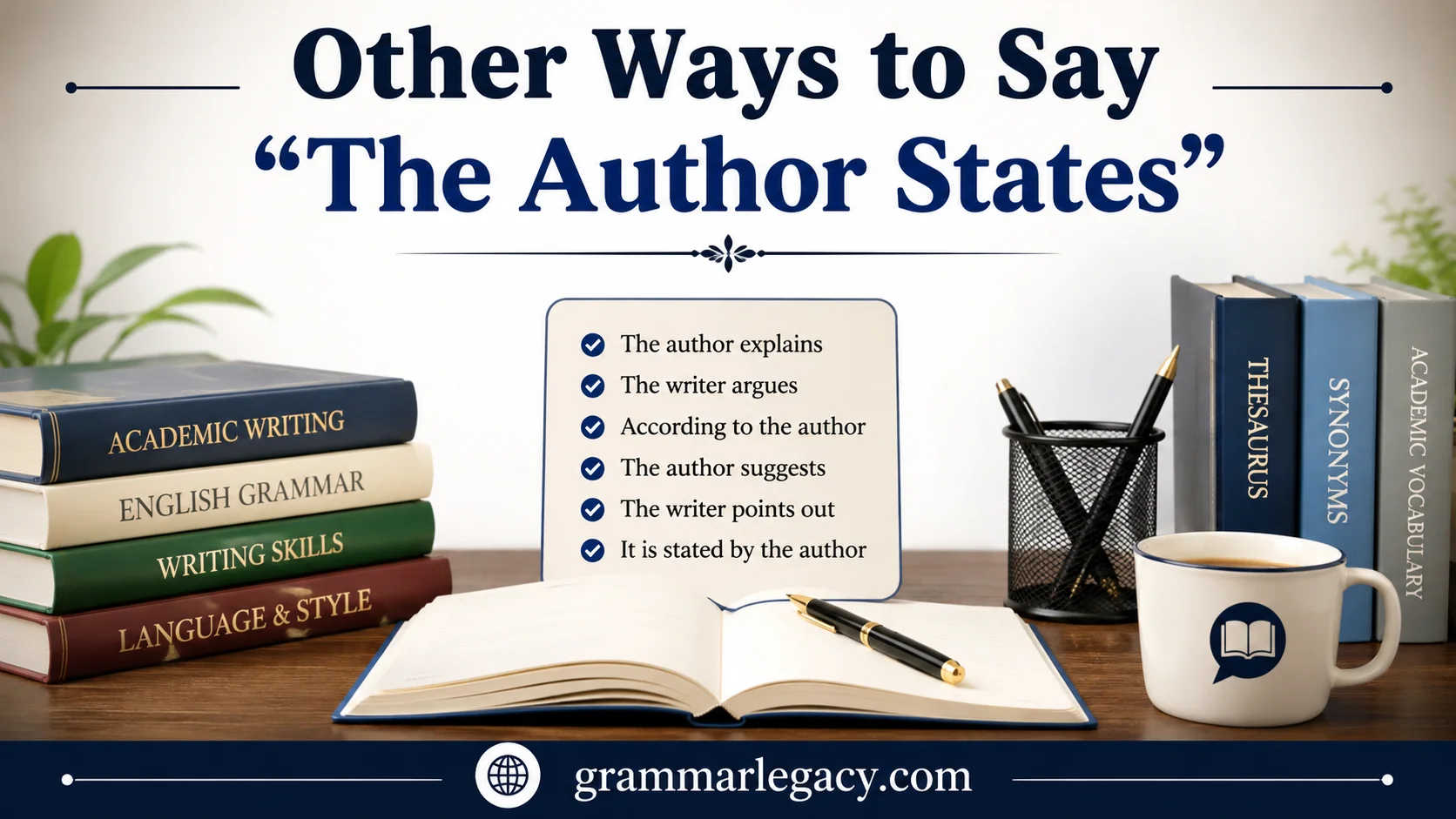

Other Ways to Say “The Author States” (With Examples) can help make academic writing more clear, engaging, precise, and professional while avoiding repetitive language.
In academic writing, repeatedly using “the author states” can make essays, reports, and articles sound predictable. Using suitable alternatives, synonyms, and dynamic verbs such as argues, explains, notes, highlights, observes, asserts, and suggests can improve clarity, flow, and meaning. The right expression depends on the context and whether you are presenting a claim, observation, suggestion, quote, or paraphrase. With thoughtful word choices, your writing can sound more natural, polished, and engaging.
Did You Know About “The Author States”?
The phrase “the author states” is one of the most commonly used reporting expressions in academic writing. While it is grammatically correct, using it repeatedly can make your paragraphs feel monotonous. Professors, editors, and examiners often encourage students to vary their reporting verbs to create smoother and more sophisticated writing.
Using alternatives such as “the author argues,” “the author explains,” or “the author emphasizes” also allows you to express the author’s tone and intent more accurately. This not only improves readability but also demonstrates critical thinking and a broader vocabulary.
What Does “The Author States” Mean?
“The author states” means that the writer clearly presents, expresses, or mentions a fact, opinion, argument, or idea in a text. It is a neutral reporting phrase commonly used in essays, research papers, book reports, and academic discussions.
For example:
The author states that climate change is one of the greatest challenges of our time.
Here, the phrase simply introduces what the author has written without adding any personal opinion.
Professional or Academic Ways to Say “The Author States”
Instead of repeating “the author states,” you can use more precise reporting verbs depending on the context.
- The author argues
- The author explains
- The author notes
- The author observes
- The author points out
- The author emphasizes
- The author suggests
- The author maintains
- The author asserts
- The author concludes
These alternatives are especially useful in essays, dissertations, research papers, and literary analyses.
“The Author States” Synonyms
- The Author Says
- The Author Explains
- The Author Mentions
- The Author Notes
- The Author Points Out
- The Author Suggests
- The Author Argues
- The Author Claims
- The Author Emphasizes
- The Author Highlights
- The Author Observes
- The Author Indicates
- The Author Reveals
- The Author Describes
- The Author Illustrates
- The Author Clarifies
- The Author Affirms
- The Author Declares
- The Author Maintains
- The Author Expresses
- The Author Discusses
- The Author Presents
- The Author Demonstrates
- The Author Confirms
- The Author Reports
- The Author Contends
- The Author Explores
- The Author Examines
- The Author Concludes
- The Author Acknowledges
1. The Author Says
Definition: “The Author Says” is a simple reporting phrase used to introduce an idea, opinion, or fact expressed by a writer. It is commonly used in informal and educational writing.
Meanings: This phrase means that the writer directly communicates information to the reader. It is a neutral expression that works well when summarizing a text or discussing an author’s viewpoint.
Example: The author says that practicing every day is the key to improving writing skills.
Detailed Explanation: “The Author Says” is one of the simplest alternatives to “The Author States.” It is easy to understand and is frequently used in classrooms, book summaries, and general discussions. Although it is perfectly correct, academic writing often benefits from more specific reporting verbs such as “explains,” “argues,” or “emphasizes” because they better describe the author’s purpose. Still, this phrase remains useful when you simply want to report what the author has written without adding interpretation.
Tone: Casual, Neutral
Best Use: School assignments, blog posts, book summaries, and informal discussions.
2. The Author Explains
Definition: “The Author Explains” means the writer provides detailed information or clarification about a topic so readers can understand it more clearly.
Meanings: It indicates that the author goes beyond simply stating a fact and carefully describes or clarifies an idea.
Example: The author explains how climate change affects coastal communities.
Detailed Explanation: This phrase is an excellent choice for academic and professional writing because it tells readers that the writer is providing reasoning, background information, or clarification. It is especially useful when discussing textbooks, research papers, or informative articles where concepts are developed in detail. Compared to “The Author Says,” it sounds more formal and analytical, making it a favorite in essays and literature reviews.
Tone: Formal, Academic
Best Use: Research papers, essays, educational articles, and literary analysis.
3. The Author Mentions
Definition: “The Author Mentions” means the writer briefly refers to a person, idea, event, or fact without discussing it in detail. It is commonly used when the information is included but is not the main focus of the text.
Meanings: This phrase indicates that the author makes a short reference to a topic. It suggests that the subject is acknowledged but not explored extensively.
Example: The author mentions the importance of healthy eating in the introduction.
Detailed Explanation: “The Author Mentions” is useful when summarizing texts that briefly touch on a subject. Unlike “The Author Explains,” which implies a detailed discussion, “The Author Mentions” simply indicates that the writer refers to something in passing. It is a neutral reporting verb that works well in book reviews, essays, article summaries, and reading responses where you need to identify supporting ideas without overstating their importance.
Tone: Neutral
Best Use: Article summaries, book reviews, essays, and classroom assignments.
4. The Author Notes
Definition: “The Author Notes” means the writer draws attention to an important fact, observation, or detail. It is one of the most common reporting verbs in academic writing.
Meanings: This phrase suggests that the author highlights a point worth remembering or considering. It often introduces supporting evidence or observations.
Example: The author notes that regular exercise improves both physical and mental health.
Detailed Explanation: “The Author Notes” is widely accepted in academic, professional, and research writing because it sounds formal while remaining objective. It allows writers to present an author’s ideas without implying agreement or disagreement. This phrase is especially effective when discussing research findings, observations, or factual information. Using it instead of repeatedly saying “The Author States” helps improve variety and makes your writing more polished.
Tone: Formal, Professional
Best Use: Academic essays, literature reviews, research papers, and analytical writing.
5. The Author Points Out
Definition: “The Author Points Out” means the writer emphasizes or directs the reader’s attention to an important fact, argument, or observation.
Meanings: It indicates that the author considers the information significant and wants readers to notice or think about it carefully.
Example: The author points out that education plays a key role in reducing poverty.
Detailed Explanation: This phrase is especially useful when discussing evidence or highlighting key ideas in academic texts. “The Author Points Out” suggests that the writer intentionally brings attention to an important issue rather than merely mentioning it. Because of its clear and authoritative tone, it is frequently used in literary analysis, research papers, and professional reports. It helps readers recognize that the information has special importance within the text.
Tone: Formal, Academic
Best Use: Research papers, analytical essays, book reviews, and professional writing.
6. The Author Suggests
Definition: “The Author Suggests” means the writer proposes an idea, possibility, or interpretation without presenting it as an absolute fact.
Meanings: It implies that the author is offering a recommendation, hint, or opinion that readers should consider rather than accept as certain.
Example: The author suggests that small lifestyle changes can significantly improve overall health.
Detailed Explanation: “The Author Suggests” is commonly used when the writer introduces ideas that invite discussion or interpretation. It is particularly effective in analytical and persuasive writing because it communicates possibility instead of certainty. This phrase is often found in research papers, opinion articles, and literary analyses where authors encourage readers to think critically about a topic rather than simply accept a conclusion.
Tone: Professional, Analytical
Best Use: Academic writing, persuasive essays, research articles, and literary analysis.
7. The Author Argues
Definition: “The Author Argues” means the writer presents a claim or viewpoint and supports it with reasons, evidence, or logical analysis.
Meanings: This phrase indicates that the author is defending a position or attempting to persuade readers of a particular idea.
Example: The author argues that renewable energy is essential for a sustainable future.
Detailed Explanation: “The Author Argues” is one of the strongest reporting verbs in academic writing because it clearly communicates that the writer is making a reasoned case. It is especially appropriate for research papers, argumentative essays, and critical analyses. Using this expression tells readers that the author’s ideas are supported by evidence and logical reasoning rather than being simple statements of fact.
Tone: Formal, Scholarly
Best Use: Argumentative essays, research papers, critical reviews, and academic discussions.
8. The Author Claims
Definition: “The Author Claims” means the writer asserts an idea, opinion, or statement that may require evidence or further examination. It is commonly used in academic and analytical writing.
Meanings: This phrase suggests that the author presents a specific viewpoint or assertion. Depending on the context, it may imply that the statement is open to evaluation or debate.
Example: The author claims that social media has permanently changed the way people communicate.
Detailed Explanation: “The Author Claims” is frequently used when discussing arguments, theories, or opinions that are supported by evidence but may not be universally accepted. It encourages readers to think critically about the statement rather than accepting it as an unquestionable fact. This reporting verb is especially valuable in research papers and literary analysis because it allows writers to remain objective while discussing another author’s position.
Tone: Formal, Analytical
Best Use: Research papers, argumentative essays, critical reviews, and academic discussions.
9. The Author Emphasizes
Definition: “The Author Emphasizes” means the writer gives special importance to a particular idea, fact, or argument.
Meanings: It indicates that the author intentionally highlights a point to ensure readers understand its significance.
Example: The author emphasizes the importance of lifelong learning in today’s rapidly changing world.
Detailed Explanation: This phrase is an excellent choice when the writer repeatedly stresses a key message or central theme. Unlike “The Author States,” which simply reports information, “The Author Emphasizes” conveys that the idea is especially important. It is commonly used in academic writing, book reviews, and article summaries to identify the main points the author wants readers to remember.
Tone: Professional, Academic
Best Use: Essays, literature reviews, educational articles, and research papers.
10. The Author Highlights
Definition: “The Author Highlights” means the writer draws attention to a significant detail, issue, or finding within the text.
Meanings: This phrase suggests that the author focuses on something important to help readers recognize its value or impact.
Example: The author highlights the challenges faced by small businesses during economic downturns.
Detailed Explanation: “The Author Highlights” is commonly used when summarizing or analyzing key ideas in books, reports, and research articles. It implies that the writer intentionally brings certain information into focus because it supports the main argument or contributes to the overall message. This expression is effective in formal writing because it sounds precise, engaging, and professional.
Tone: Formal, Informative
Best Use: Academic essays, reports, presentations, and analytical writing.
11. The Author Observes
Definition: “The Author Observes” means the writer notices or comments on a fact, pattern, behavior, or situation based on careful examination.
Meanings: It indicates that the author shares an observation derived from experience, research, or close analysis.
Example: The author observes that young readers are increasingly interested in digital books.
Detailed Explanation: This reporting verb is especially useful when discussing findings or thoughtful reflections. “The Author Observes” suggests that the writer has carefully examined a topic before presenting an insight. It often appears in literary criticism, research papers, and social science writing where observations are used to support broader conclusions. Using this phrase adds sophistication and precision to your academic writing.
Tone: Academic, Objective
Best Use: Research papers, literary analysis, scholarly articles, and book reviews.
12. The Author Indicates
Definition: “The Author Indicates” means the writer indirectly or directly shows, points to, or suggests a particular fact or conclusion.
Meanings: This phrase implies that the author’s words provide evidence or signals that lead readers toward a specific understanding.
Example: The author indicates that early intervention can improve learning outcomes.
Detailed Explanation: “The Author Indicates” is widely used in formal and academic writing because it communicates ideas in a careful and objective manner. It is particularly effective when discussing research findings, statistical evidence, or implied meanings. Rather than making bold statements, this reporting verb suggests that the author’s writing leads readers to a logical conclusion based on the information presented.
Tone: Formal, Professional
Best Use: Research articles, academic essays, reports, and scientific writing.
13. The Author Reveals
Definition: “The Author Reveals” means the writer uncovers, discloses, or makes previously unknown information known to the reader. It often introduces surprising facts or important discoveries.
Meanings: This phrase indicates that the author shares information that provides new insight or exposes something significant. It suggests that readers learn something meaningful through the text.
Example: The author reveals that many ancient civilizations used advanced engineering techniques.
Detailed Explanation: “The Author Reveals” is a powerful reporting verb that adds impact to your writing. It is commonly used when discussing novels, biographies, investigative articles, or research papers where new information is presented. Unlike “The Author States,” which is neutral, this phrase implies that the author uncovers information that readers may not have known before. It creates curiosity and highlights the importance of the author’s message, making it an excellent choice for analytical and descriptive writing.
Tone: Formal, Engaging
Best Use: Book reviews, literary analysis, research papers, and feature articles.
14. The Author Describes
Definition: “The Author Describes” means the writer provides detailed information about a person, place, event, object, or idea to help readers understand it clearly.
Meanings: This phrase indicates that the author paints a clear picture through words by explaining characteristics, actions, or events.
Example: The author describes the village as peaceful and surrounded by green hills.
Detailed Explanation: “The Author Describes” is especially useful when referring to passages that contain vivid details or explanations. It tells readers that the writer carefully explains how something looks, feels, or works. This reporting verb is common in literature, storytelling, historical writing, and descriptive essays. It is also valuable in academic writing when summarizing how an author explains a concept or process.
Tone: Neutral, Descriptive
Best Use: Literary essays, novels, historical analysis, and descriptive writing.
15. The Author Illustrates
Definition: “The Author Illustrates” means the writer explains an idea by using examples, comparisons, stories, or evidence to make it easier to understand.
Meanings: It suggests that the author supports a point by providing practical examples or detailed explanations.
Example: The author illustrates the benefits of teamwork through several real-life examples.
Detailed Explanation: This reporting verb is ideal when the writer uses evidence, anecdotes, or examples to strengthen an argument. “The Author Illustrates” shows that the author is not merely stating an idea but is helping readers visualize or better understand it. It is commonly used in educational writing, research papers, and literary analysis because it emphasizes the use of supporting material to explain complex concepts.
Tone: Academic, Informative
Best Use: Research papers, educational articles, analytical essays, and presentations.
Read More: 30 Other Ways to Say “The Text States” (With Examples)
16. The Author Clarifies
Definition: “The Author Clarifies” means the writer makes an idea, statement, or concept easier to understand by providing additional explanation.
Meanings: This phrase indicates that the author removes confusion and helps readers gain a clearer understanding of the topic.
Example: The author clarifies the difference between leadership and management.
Detailed Explanation: “The Author Clarifies” is an excellent reporting verb when discussing explanations that eliminate misunderstandings or answer possible questions. It is especially common in academic writing, instructional materials, and textbooks where the author’s goal is to improve readers’ understanding. Compared with “The Author States,” this expression emphasizes explanation rather than simple presentation, making it more precise in many contexts.
Tone: Professional, Educational
Best Use: Academic essays, textbooks, instructional guides, and research articles.
17. The Author Affirms
Definition: “The Author Affirms” means the writer confidently confirms or supports a statement, belief, or conclusion.
Meanings: It suggests that the author expresses certainty and reinforces an idea with confidence or evidence.
Example: The author affirms that consistent practice leads to long-term success.
Detailed Explanation: “The Author Affirms” is often used when the writer strongly supports a conclusion or firmly expresses a belief. It carries a sense of confidence and assurance, making it suitable for scholarly articles, persuasive essays, and professional discussions. This reporting verb indicates that the author is not simply presenting information but is confirming it based on reasoning, evidence, or experience.
Tone: Formal, Confident
Best Use: Academic research, persuasive writing, scholarly articles, and critical analysis.
18. The Author Declares
Definition: “The Author Declares” means the writer makes a strong, clear, and confident statement about a particular idea or belief. It often conveys certainty and authority.
Meanings: This phrase indicates that the author openly announces or firmly expresses a viewpoint. It usually emphasizes confidence and conviction.
Example: The author declares that education is the foundation of a successful society.
Detailed Explanation: “The Author Declares” is a powerful reporting verb that suggests the writer is making an authoritative statement. It is stronger than “The Author States” because it conveys confidence and determination. This expression is commonly found in persuasive essays, speeches, opinion pieces, and literary analysis where the author’s message is presented with conviction. Use this phrase when you want to highlight the certainty behind an author’s words.
Tone: Formal, Assertive
Best Use: Persuasive essays, opinion articles, speeches, and literary criticism.
19. The Author Maintains
Definition: “The Author Maintains” means the writer continues to support or defend a particular opinion, belief, or argument throughout the text.
Meanings: It suggests that the author consistently holds the same viewpoint and supports it with evidence or reasoning.
Example: The author maintains that effective communication is essential for successful leadership.
Detailed Explanation: “The Author Maintains” is widely used in academic writing because it indicates that the writer consistently defends a position. It often appears in argumentative essays and research papers where the author presents evidence to support a central claim. Unlike “The Author Claims,” which may sound more neutral or skeptical, “The Author Maintains” implies a sustained commitment to a particular perspective.
Tone: Academic, Formal
Best Use: Research papers, argumentative essays, critical reviews, and scholarly discussions.
20. The Author Expresses
Definition: “The Author Expresses” means the writer communicates thoughts, emotions, opinions, or ideas through writing.
Meanings: This phrase indicates that the author conveys feelings, viewpoints, or beliefs in a clear and meaningful way.
Example: The author expresses concern about the effects of environmental pollution.
Detailed Explanation: “The Author Expresses” is a versatile reporting verb that can be used in both academic and creative writing. It is especially appropriate when discussing emotions, opinions, or personal perspectives rather than factual information. This expression allows writers to focus on how an author communicates ideas and feelings, making it useful in literary analysis, book reviews, and reflective essays.
Tone: Neutral, Professional
Best Use: Literary analysis, essays, book reviews, and reflective writing.
21. The Author Discusses
Definition: “The Author Discusses” means the writer examines or talks about a topic in detail by presenting explanations, ideas, or arguments.
Meanings: It suggests that the author explores a subject thoroughly rather than simply mentioning it.
Example: The author discusses the impact of artificial intelligence on modern education.
Detailed Explanation: “The Author Discusses” is one of the most useful reporting verbs in academic writing because it indicates a detailed exploration of a topic. It works well when summarizing chapters, articles, or research papers that analyze issues from different perspectives. Unlike “The Author Mentions,” which implies a brief reference, this phrase communicates that the author examines the subject in depth.
Tone: Formal, Academic
Best Use: Research papers, essays, article summaries, and literature reviews.
22. The Author Presents
Definition: “The Author Presents” means the writer introduces information, ideas, evidence, or arguments to the reader in a structured manner.
Meanings: This phrase indicates that the author offers facts, viewpoints, or findings for readers to consider.
Example: The author presents several solutions to reduce air pollution.
Detailed Explanation: “The Author Presents” is a highly professional reporting verb commonly used in research papers, reports, and analytical essays. It suggests that the writer organizes and introduces information logically without necessarily arguing for one side. This expression is particularly useful when describing research findings, theories, or evidence because it sounds objective and academically appropriate.
Tone: Professional, Objective
Best Use: Academic essays, research articles, reports, and presentations.
23. The Author Demonstrates
Definition: “The Author Demonstrates” means the writer clearly proves or shows an idea through evidence, facts, examples, or logical reasoning.
Meanings: This phrase suggests that the author provides convincing support for a point instead of merely stating it. It emphasizes proof and explanation.
Example: The author demonstrates that regular reading improves vocabulary and critical thinking skills.
Detailed Explanation: “The Author Demonstrates” is an excellent reporting verb for academic and research writing because it implies that the author supports a claim with substantial evidence. Rather than simply presenting an opinion, the writer shows readers why the conclusion is valid. This phrase is especially common in scientific papers, analytical essays, and scholarly articles where evidence plays a central role. Using it instead of “The Author States” adds precision and authority to your writing.
Tone: Formal, Academic
Best Use: Research papers, scientific reports, analytical essays, and scholarly writing.
24. The Author Confirms
Definition: “The Author Confirms” means the writer verifies or supports a fact, statement, or conclusion with reliable evidence or information.
Meanings: This phrase indicates that the author strengthens or validates an existing idea by providing proof or certainty.
Example: The author confirms that exercise has long-term benefits for mental health.
Detailed Explanation: “The Author Confirms” is commonly used when the writer provides evidence that supports an existing belief or finding. It conveys certainty and reliability, making it an excellent choice for academic writing and research discussions. This reporting verb suggests that the information is backed by facts, experiments, or credible sources rather than personal opinion. It helps create a professional and trustworthy tone.
Tone: Professional, Confident
Best Use: Research papers, academic journals, scientific studies, and formal reports.
25. The Author Reports
Definition: “The Author Reports” means the writer presents facts, findings, observations, or events in an objective and informative manner.
Meanings: It indicates that the author communicates information without necessarily expressing a personal opinion or argument.
Example: The author reports that unemployment rates have decreased over the past year.
Detailed Explanation: “The Author Reports” is widely used in journalism, academic writing, and research because it emphasizes objectivity. It is particularly appropriate when discussing statistics, study results, surveys, or factual events. Unlike “The Author Argues,” which introduces a position, this phrase simply conveys information in a neutral and factual way. It is an excellent choice when summarizing research findings or news articles.
Tone: Neutral, Formal
Best Use: Research summaries, news articles, academic papers, and technical reports.
26. The Author Contends
Definition: “The Author Contends” means the writer strongly argues or insists that a particular idea or viewpoint is correct.
Meanings: This phrase suggests that the author presents a well-supported argument and actively defends it against opposing views.
Example: The author contends that technological innovation is essential for economic growth.
Detailed Explanation: “The Author Contends” is a sophisticated reporting verb often found in scholarly writing and critical analysis. It indicates that the author is presenting a carefully reasoned argument supported by evidence. This phrase is stronger than “The Author Suggests” because it conveys greater confidence and determination. It is especially useful when analyzing persuasive texts, research papers, and argumentative essays.
Tone: Academic, Assertive
Best Use: Argumentative essays, scholarly articles, literary criticism, and research papers.
27. The Author Explores
Definition: “The Author Explores” means the writer examines a topic, idea, or issue in depth from different perspectives.
Meanings: It indicates that the author investigates or analyzes a subject thoroughly rather than reaching a quick conclusion.
Example: The author explores the relationship between culture and language.
Detailed Explanation: “The Author Explores” is commonly used when discussing books, essays, or research that investigate complex subjects. It suggests that the writer carefully considers multiple viewpoints, examples, and possibilities before drawing conclusions. This reporting verb is especially effective in literary analysis and academic writing because it highlights thoughtful examination instead of simple explanation. It gives your writing a more analytical and sophisticated tone.
Tone: Analytical, Academic
Best Use: Literary analysis, research papers, book reviews, and academic essays.
28. The Author Examines
Definition: “The Author Examines” means the writer carefully analyzes, investigates, or studies a topic, issue, or idea in detail.
Meanings: This phrase indicates that the author looks closely at a subject to understand its causes, effects, or significance. It suggests a thoughtful and systematic analysis.
Example: The author examines the impact of social media on adolescent mental health.
Detailed Explanation: “The Author Examines” is one of the strongest reporting verbs for academic writing because it emphasizes careful analysis rather than simple description. It is frequently used in research papers, literary criticism, and analytical essays where the writer evaluates evidence, compares viewpoints, or investigates complex issues. Using this phrase instead of “The Author States” makes your writing sound more scholarly and demonstrates a deeper understanding of the author’s approach.
Tone: Formal, Analytical
Best Use: Research papers, literary analysis, academic essays, and critical reviews.
29. The Author Concludes
Definition: “The Author Concludes” means the writer reaches a final judgment, summary, or decision after presenting evidence or discussion.
Meanings: This phrase suggests that the author ends the discussion by presenting the main takeaway or final opinion based on the information provided.
Example: The author concludes that renewable energy is the most sustainable solution for the future.
Detailed Explanation: “The Author Concludes” is commonly used when referring to the final section of a book, article, or research paper. It indicates that the writer has analyzed the evidence and arrived at a reasoned conclusion. This reporting verb is particularly valuable in academic writing because it helps readers identify the author’s final message or recommendation. It also creates a smooth transition when summarizing the ending of a discussion.
Tone: Formal, Academic
Best Use: Research papers, essays, literature reviews, academic reports, and article summaries.
30. The Author Acknowledges
Definition: “The Author Acknowledges” means the writer recognizes, admits, or gives credit to a fact, limitation, opinion, or contribution.
Meanings: This phrase indicates that the author openly accepts or recognizes something important, even if it does not fully support the main argument.
Example: The author acknowledges that additional research is needed before drawing definite conclusions.
Detailed Explanation: “The Author Acknowledges” is an excellent reporting verb for academic and professional writing because it shows that the writer recognizes alternative viewpoints, limitations, or supporting contributions. It is frequently used in research papers, scholarly articles, and critical essays where authors admit the boundaries of their studies or recognize opposing evidence. This phrase demonstrates honesty and intellectual integrity, making it a valuable alternative to “The Author States.”
Tone: Professional, Objective
Best Use: Academic research, literature reviews, scholarly articles, critical analysis, and professional reports.
FAQs :
1. What are other ways to say “The Author States”?
Some useful alternatives include the author argues, the author explains, the author notes, the author suggests, the author observes, and the author highlights. Choose the phrase that best matches the author’s specific idea.
2. Can I use “The Author States” in academic writing?
Yes, “The Author States” is appropriate for academic writing. However, repeating it too often can make your essay sound monotonous. Using suitable alternatives can improve your writing style.
3. What is a formal alternative to “The Author States”?
Formal alternatives include “the author asserts,” “the author maintains,” “the author argues,” and “the author contends.” These expressions are useful when discussing academic arguments or strong viewpoints.
4. Which verb should I use for an author’s opinion?
Use verbs according to the strength and purpose of the statement. Argues suggests a reasoned position, suggests indicates a possibility, observes presents an insight, and asserts expresses a strong claim.
5. Why should I avoid repeating “The Author States”?
Repeating the same phrase can make your writing feel repetitive and predictable. Using varied reporting verbs creates better flow, clarity, precision, and engagement while helping readers understand the author’s intended meaning.
Conclusion :
Using Other Ways to Say “The Author States” can make academic writing more varied, precise, and professional. Instead of repeating one expression, choose reporting verbs such as argues, explains, notes, highlights, observes, asserts, or suggests based on the context. The right word can show whether an author is presenting an argument, observation, opinion, or suggestion, helping your essays, reports, and articles communicate ideas with greater clarity and confidence.