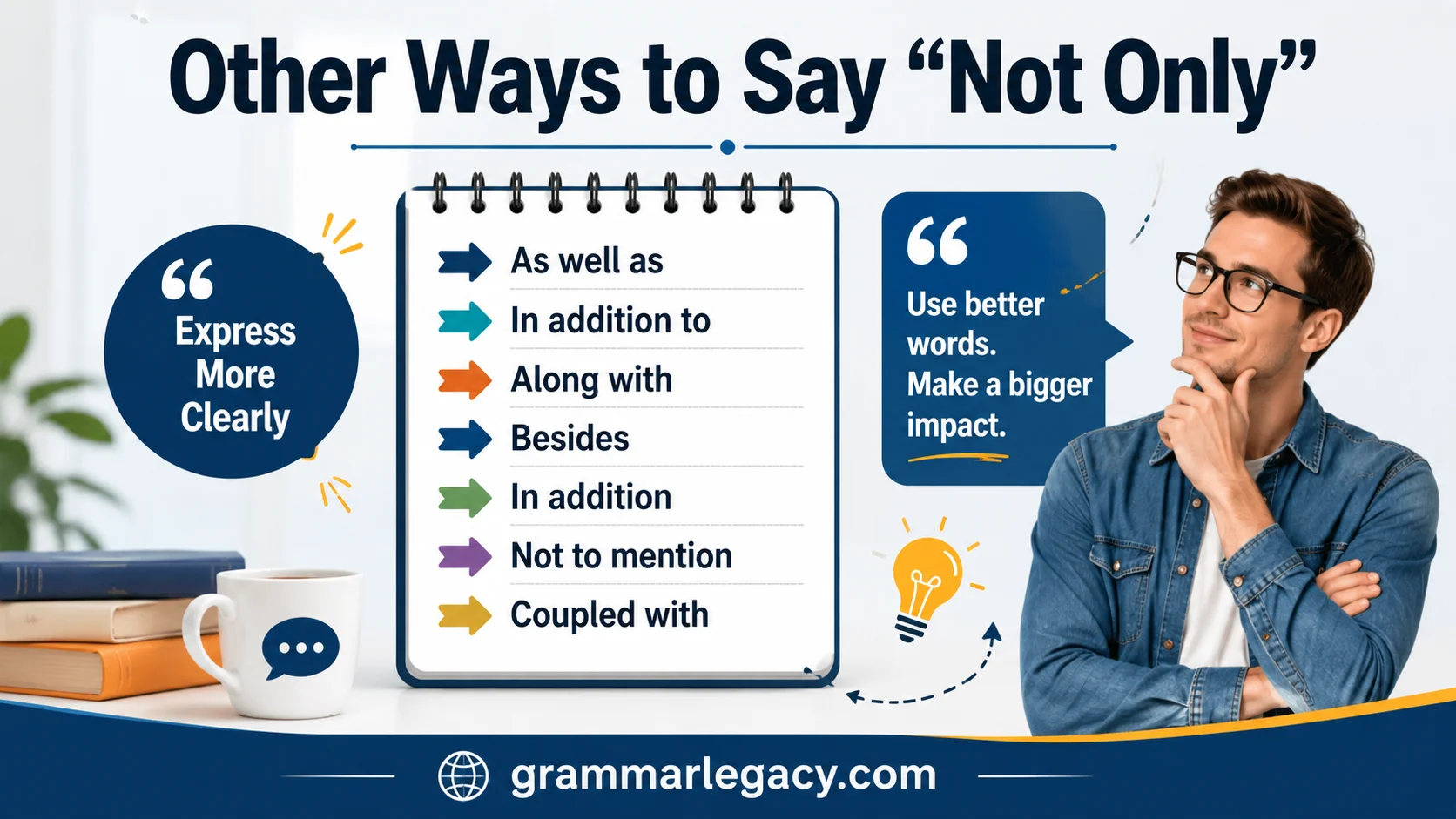

The phrase Other Ways to Say “Not Only” can make your writing more engaging, natural, and expressive. Instead of repeating the same words, you can use different alternatives that improve sentence structure, add emphasis, and create a smoother logical flow. Whether you are writing academic essays, business emails, or casual conversations, choosing the right expression helps your message sound clearer, more professional, and easier for readers to understand.
Using a variety of expressions also improves your communication by matching the right tone, purpose, and audience. In my experience, replacing common phrases with suitable alternatives makes your content feel fresh and polished without changing the meaning. This guide will introduce useful synonyms, explain when to use them, and provide practical examples so you can write with greater confidence and avoid unnecessary repetition.
Did You Know About “Not Only”?
“Not only” is a powerful English phrase used to introduce an additional point after mentioning the first one. It often appears with “but also” to show that two things are equally important.
For example:
“She is not only talented but also hardworking.”
Here, “not only” highlights the first quality, while “but also” introduces another positive quality. This structure is widely used in formal writing, speeches, literature, and everyday conversations.
What Does “Not Only” Mean?
The phrase “not only” means “in addition to,” “besides,” or “as well as.” It is used when you want to say that something includes more than one quality, action, or fact.
For example:
“The movie was not only entertaining but also educational.”
This means the movie had two qualities: it was entertaining and educational. The phrase helps create stronger emphasis and gives more information to the listener or reader.
Professional or Political Ways to Say “Not Only”
In professional, academic, or political communication, alternatives to “not only” can make statements sound more polished and persuasive. Some useful expressions include:
- Furthermore
- Additionally
- In addition
- Beyond that
- Moreover
- Along with
- As well as
- Combined with
- Together with
- Besides
Example:
“The policy will not only improve education but also strengthen economic growth.”
Professional alternative:
“The policy will improve education; furthermore, it will strengthen economic growth.”
“Not Only” Synonyms
- Not Just
- Besides
- In Addition To
- As Well As
- Along With
- Together With
- Furthermore
- Moreover
- Additionally
- What’s More
- Beyond That
- Apart From
- Over And Above
- Combined With
- Added To This
- On Top Of That
- Plus
- Including
- Coupled With
- Accompanied By
- Linked With
- Supported By
- Alongside
- Together With The Fact That
- Not Merely
- Not Simply
- More Than Just
- In The Same Way
- Equally Important
- As A Further Point
1. Not Just
Definition: “Not just” is a simple and natural alternative to “not only.” It shows that something includes an additional quality, action, or feature.
Meanings: The phrase “not just” means something is more than one thing or goes beyond a single example. It is commonly used in everyday conversations and informal writing.
Example: “She is not just a good teacher; she is also a great mentor.”
Detailed Explanation: “Not just” is one of the most common replacements for “not only” because it sounds natural and conversational. It helps speakers emphasize that a person, object, or situation has more value than expected. This phrase works well when introducing an additional point that makes the statement stronger. It can be used in casual conversations, interviews, articles, and presentations.
Tone: Casual, natural, and conversational.
Best Use: Use “not just” in daily conversations, blogs, social media, and friendly professional communication.
2. Besides
Definition: “Besides” is used to introduce another reason, fact, or point in addition to what has already been mentioned.
Meanings: It means “in addition to” or “apart from.” It helps add extra information while keeping the sentence connected.
Example: “Besides being talented, she is also very dedicated.”
Detailed Explanation: “Besides” is a flexible word that can replace “not only” when you want to add another important detail. It is often used when explaining reasons or giving extra support for an idea. This word creates a smooth transition between thoughts and makes communication clearer. It is suitable for both spoken and written English.
Tone: Neutral and informative.
Best Use: Use it in conversations, essays, explanations, and informal professional writing.
3. In Addition To
Definition: “In addition to” is a formal phrase used to show that something exists along with another thing.
Meanings: It means “as well as” or “along with.” It introduces extra information, features, or responsibilities.
Example: “In addition to her skills, she has years of experience.”
Detailed Explanation: “In addition to” is commonly used in formal writing because it sounds organized and professional. It clearly shows that another point is being added to the previous information. This phrase is useful in reports, academic writing, business communication, and official documents. It helps writers avoid repetition and create smoother sentences.
Tone: Formal and professional.
Best Use: Use it in business documents, academic writing, reports, and presentations.
4. As Well As
Definition: “As well as” is an expression used to add another person, thing, or idea to a statement.
Meanings: It means “in addition to” or “together with.” It connects two related ideas naturally.
Example: “He speaks English as well as Spanish.”
Detailed Explanation: “As well as” is a widely used alternative for “not only” because it works in many situations. It can describe skills, qualities, actions, or objects that exist together. This phrase is common in both spoken and written English. It helps create balanced sentences without sounding too formal.
Tone: Friendly and neutral.
Best Use: Use it in everyday communication, articles, and general writing.
5. Along With
Definition: “Along with” is a phrase used to show that something is included together with another thing. It highlights an additional person, quality, action, or idea connected to the main point.
Meanings: The phrase “along with” means “together with,” “in addition to,” or “accompanied by.” It is used when adding another element to a sentence without creating a strong contrast.
Example: “The company provides training along with career development opportunities.”
Detailed Explanation: “Along with” is a natural alternative to “not only” when you want to mention another important detail. It is commonly used in professional conversations, descriptions, and everyday speech. This phrase helps show that two things exist together and that both contribute value. It creates a smooth connection between ideas and makes sentences easier to understand.
Tone: Neutral, friendly, and professional.
Best Use: Use “along with” in workplace communication, articles, descriptions, and casual conversations.
6. Together With
Definition: “Together with” expresses that two or more things are combined or included at the same time. It emphasizes connection, partnership, and addition.
Meanings: The phrase means “in combination with,” “alongside,” or “as well as.” It is often used when two elements work or exist together.
Example: “Her creativity, together with her determination, helped her achieve success.”
Detailed Explanation: “Together with” is a useful replacement for “not only” because it focuses on the relationship between two ideas. It is often found in formal writing, business communication, and descriptions of achievements. This phrase shows that one quality or action is supported by another. It gives sentences a balanced and organized structure.
Tone: Formal and polished.
Best Use: Use it in professional documents, reports, presentations, and formal statements.
7. Furthermore
Definition: “Furthermore” is a transition word used to introduce an additional point or supporting idea. It adds more information while strengthening the previous statement.
Meanings: It means “in addition,” “moreover,” or “also.” It is mainly used to connect ideas in formal writing and speech.
Example: “The project is affordable; furthermore, it provides long-term benefits.”
Detailed Explanation: “Furthermore” is a strong alternative to “not only” in academic and professional contexts. It allows writers to introduce another important point without repeating the same structure. This word is especially useful when presenting arguments, explaining advantages, or highlighting multiple benefits. It creates a logical flow between sentences and makes communication sound more organized.
Tone: Formal, academic, and professional.
Best Use: Use “furthermore” in essays, business reports, research papers, and official speeches.
8. Moreover
Definition: “Moreover” is a formal linking word used to add extra information that supports or strengthens an idea. It introduces an additional point that is considered important.
Meanings: The word means “besides,” “in addition,” or “what is more.” It is commonly used to emphasize another fact or argument.
Example: “The product is affordable; moreover, it is environmentally friendly.”
Detailed Explanation: “Moreover” works as an excellent alternative to “not only” when writing formal content. It helps writers add another reason, benefit, or feature in a clear way. This word is frequently used in articles, academic papers, and professional discussions. It makes the sentence sound more thoughtful and persuasive.
Tone: Professional and formal.
Best Use: Use it in academic writing, business communication, reports, and persuasive content.
9. Additionally
Definition: “Additionally” is used to introduce extra information or another point related to the main idea. It helps expand a statement by adding another important detail.
Meanings: It means “also,” “besides,” or “in addition.” It is commonly used in formal and professional communication.
Example: “The service is reliable. Additionally, it is available at an affordable price.”
Detailed Explanation: “Additionally” is a clear and professional substitute for “not only.” It allows speakers and writers to add information without making sentences complicated. This word is especially useful when listing benefits, features, or reasons. It creates a logical connection between ideas and improves the overall flow of writing.
Tone: Formal, clear, and professional.
Best Use: Use “additionally” in reports, presentations, emails, and informative articles.
10. What’s More
Definition: “What’s more” is an expression used to introduce an extra point that makes a statement stronger. It adds emphasis by showing that another positive or important detail exists.
Meanings: It means “in addition,” “even more,” or “besides that.” It is often used to highlight something surprising or valuable.
Example: “The hotel offers beautiful rooms, and what’s more, the service is excellent.”
Detailed Explanation: “What’s more” is a conversational alternative to “not only” that adds energy and emphasis to a sentence. It is commonly used in speeches, blogs, storytelling, and everyday discussions. This phrase helps create excitement when introducing another benefit or fact. Unlike very formal words, it sounds natural and engaging.
Tone: Friendly, expressive, and conversational.
Best Use: Use it in blogs, presentations, conversations, and creative writing.
11. Beyond That
Definition: “Beyond that” is a phrase used to introduce something additional that goes further than the point already mentioned. It shows that there is another important aspect, quality, or reason to consider.
Meanings: The phrase “beyond that” means “in addition to that,” “apart from that,” or “furthermore.” It is used to expand an idea and mention something extra.
Example: “The course teaches technical skills, and beyond that, it helps students develop confidence.”
Detailed Explanation: “Beyond that” is a useful alternative to “not only” when you want to show that something offers more than expected. It creates a sense of continuation and encourages the reader or listener to think about additional benefits. This phrase works well in conversations, presentations, and descriptive writing. It helps express that the second point goes further than the first one.
Tone: Natural, thoughtful, and conversational.
Best Use: Use “beyond that” in discussions, speeches, articles, and personal explanations.
12. Apart From
Definition: “Apart from” is used to introduce something separate from or additional to the main subject. It helps mention another fact, feature, or exception connected to an idea.
Meanings: The phrase means “besides,” “in addition to,” or “except for.” Its meaning depends on the context in which it is used.
Example: “Apart from being a talented artist, she is also a skilled writer.”
Detailed Explanation: “Apart from” can replace “not only” when adding another quality or characteristic. It is commonly used in both British and international English. This phrase allows speakers and writers to provide extra information without repeating the same sentence structure. It is helpful when describing people, experiences, skills, and situations with multiple qualities.
Tone: Neutral and flexible.
Best Use: Use it in everyday conversations, descriptions, essays, and general writing.
13. Over And Above
Definition: “Over and above” is an expression that shows something extra beyond what is already expected or mentioned. It emphasizes additional value, effort, or importance.
Meanings: It means “in addition to,” “more than,” or “beyond.” It is often used to describe extra contributions or qualities.
Example: “She provided excellent service over and above her regular responsibilities.”
Detailed Explanation: “Over and above” is a strong alternative to “not only” when highlighting something that exceeds expectations. It is often used in professional settings to praise extra effort or achievement. This expression gives the idea that someone has done more than what was required. It adds a positive and appreciative feeling to communication.
Tone: Appreciative, professional, and positive.
Best Use: Use it in workplace discussions, reviews, compliments, and formal descriptions.
14. Combined With
Definition: “Combined with” shows that one thing is added together with another to create a complete result. It emphasizes the relationship between two or more elements.
Meanings: The phrase means “together with,” “alongside,” or “in partnership with.” It highlights how different factors work together.
Example: “Her experience, combined with her knowledge, makes her an excellent leader.”
Detailed Explanation: “Combined with” is a professional alternative to “not only” because it focuses on how different qualities contribute together. It is frequently used in business, science, research, and analytical writing. This phrase helps explain why certain results happen by connecting multiple factors. It makes sentences sound clear and logical.
Tone: Formal, analytical, and professional.
Best Use: Use it in reports, research articles, business writing, and explanations.
15. Added To This
Definition: “Added to this” introduces another point, fact, or reason that strengthens the previous statement. It shows that more information is being included.
Meanings: It means “in addition to this,” “besides this,” or “along with this.” It helps continue an explanation smoothly.
Example: “The apartment is spacious. Added to this, it has a beautiful view.”
Detailed Explanation: “Added to this” is a useful phrase when you want to include another important detail after making a statement. It is especially helpful in descriptive writing and explanations where multiple points need to be connected. This phrase makes the transition between ideas clear and natural. It allows writers to build stronger arguments by adding supporting information.
Tone: Neutral and explanatory.
Best Use: Use it in articles, reviews, explanations, and structured writing.
Also Read This: 30 Other Ways to Say “Sorry to Hear That” (With Examples)
16. On Top Of That
Definition: “On top of that” is an informal phrase used to add another point or situation. It often emphasizes that the additional information makes the situation stronger or more noticeable.
Meanings: The phrase means “in addition,” “besides,” or “also.” It is commonly used in casual speech.
Example: “He finished the project early, and on top of that, he improved the design.”
Detailed Explanation: “On top of that” is a natural conversational alternative to “not only.” It is often used when sharing experiences, explaining situations, or emphasizing multiple advantages. This phrase adds personality and emotion to communication. While it is less formal than “furthermore” or “moreover,” it sounds friendly and relatable.
Tone: Casual, expressive, and conversational.
Best Use: Use it in conversations, blogs, personal stories, and informal writing.
17. Plus
Definition: “Plus” is a simple word used to add another point, feature, or reason to a statement. It shows that something extra is included along with the main idea.
Meanings: The word “plus” means “in addition,” “also,” or “as well as.” It is commonly used in casual conversations and informal writing to connect ideas.
Example: “The phone is affordable, plus it has a high-quality camera.”
Detailed Explanation: “Plus” is a short and natural alternative to “not only” that works well when adding another benefit or detail. It is often used in everyday speech because it sounds friendly and direct. Although it is less formal than words like “moreover” or “furthermore,” it effectively shows that another point should be considered. This word is especially useful when listing advantages, features, or reasons in a simple way.
Tone: Casual, friendly, and conversational.
Best Use: Use “plus” in daily conversations, social media posts, advertisements, and informal writing.
18. Including
Definition: “Including” is used to show that something is part of a larger group, list, or idea. It introduces additional examples or important details connected to the main subject.
Meanings: The word means “containing,” “involving,” or “with the addition of.” It helps explain that more elements are part of something.
Example: “The program offers many benefits, including career guidance and practical training.”
Detailed Explanation: “Including” can replace “not only” when you want to mention extra examples or features. It is widely used in professional documents, descriptions, reports, and educational materials. This word helps make information clearer by showing specific details that support the main statement. It is useful when explaining what is covered within a broader topic.
Tone: Informative, neutral, and professional.
Best Use: Use it in reports, articles, product descriptions, and educational writing.
19. Coupled With
Definition: “Coupled with” is a phrase that shows two things are connected or combined together. It highlights how one factor works together with another to create an effect.
Meanings: The phrase means “combined with,” “together with,” or “alongside.” It is often used when explaining relationships between ideas.
Example: “Her strong communication skills, coupled with her experience, made her the perfect candidate.”
Detailed Explanation: “Coupled with” is a polished alternative to “not only” that is commonly found in formal writing. It helps explain how multiple qualities, factors, or situations contribute to a result. This phrase gives sentences a professional and analytical style. It is especially useful when discussing achievements, research findings, or business decisions.
Tone: Formal, professional, and analytical.
Best Use: Use it in academic writing, business reports, resumes, and professional discussions.
20. Accompanied By
Definition: “Accompanied by” shows that one thing exists or happens together with another thing. It emphasizes the presence of an additional element connected to the main subject.
Meanings: It means “along with,” “together with,” or “supported by.” It is often used to describe situations where two things appear together.
Example: “The new policy was accompanied by several improvements in public services.”
Detailed Explanation: “Accompanied by” is a useful alternative to “not only” when describing events, changes, or qualities that appear together. It creates a formal and descriptive style that works well in professional communication. This phrase helps readers understand that one thing comes with another related element. It is commonly used in news articles, reports, and official statements.
Tone: Formal, descriptive, and professional.
Best Use: Use it in reports, news writing, academic content, and official communication.
21. Linked With
Definition: “Linked with” shows that two ideas, actions, or qualities are connected in some way. It emphasizes a relationship between different elements.
Meanings: The phrase means “connected to,” “associated with,” or “related to.” It explains how one thing is connected to another.
Example: “The company’s success is linked with its strong customer service.”
Detailed Explanation: “Linked with” can be used instead of “not only” when explaining connections between two important points. It is useful in analytical writing because it shows that different factors influence each other. This phrase is common in research, business discussions, and explanations. It helps create a logical relationship between ideas.
Tone: Professional, analytical, and neutral.
Best Use: Use it in research papers, reports, articles, and informative writing.
22. Supported By
Definition: “Supported by” indicates that one thing is strengthened or confirmed by another thing. It shows that additional information adds value or credibility.
Meanings: It means “backed by,” “reinforced by,” or “strengthened by.” It is often used when presenting evidence or additional support.
Example: “The argument is supported by strong evidence and detailed research.”
Detailed Explanation: “Supported by” is a strong alternative to “not only” when discussing ideas, claims, or achievements. It helps show that an additional factor makes the main point more reliable or effective. This phrase is widely used in academic, professional, and analytical contexts. It creates a sense of trust and clarity in communication.
Tone: Formal, reliable, and professional.
Best Use: Use it in essays, research, reports, presentations, and persuasive writing.
23. Alongside
Definition: “Alongside” is a word used to show that something exists, happens, or works together with another thing. It highlights addition, partnership, or connection between two related ideas.
Meanings: The word “alongside” means “next to,” “together with,” or “in addition to.” It is used to describe situations where two things are present at the same time.
Example: “She works alongside her team members to complete important projects.”
Detailed Explanation: “Alongside” is a smooth alternative to “not only” when you want to mention another person, quality, or action that exists together with the main idea. It creates a sense of teamwork, balance, and connection. This word is often used in professional, creative, and descriptive writing. It helps make sentences more natural while showing that multiple elements contribute to a situation.
Tone: Professional, friendly, and collaborative.
Best Use: Use “alongside” in workplace communication, articles, descriptions, and formal conversations.
24. Together With The Fact That
Definition: “Together with the fact that” is a phrase used to introduce an additional reason, detail, or supporting point. It emphasizes that another fact should also be considered.
Meanings: This phrase means “in addition to the fact that,” “combined with the idea that,” or “along with the reality that.” It is used to connect multiple points in a detailed explanation.
Example: “The city is attractive, together with the fact that it offers excellent educational opportunities.”
Detailed Explanation: “Together with the fact that” is a more detailed alternative to “not only” and is commonly used when explaining complex ideas. It allows writers to introduce another important point while maintaining a logical flow. This expression is useful when discussing reasons, advantages, or supporting evidence. Although it is longer, it provides clarity and emphasis in formal writing.
Tone: Formal, explanatory, and academic.
Best Use: Use it in essays, reports, research writing, and detailed explanations.
25. Not Merely
Definition: “Not merely” is a formal expression used to show that something is more than a simple or limited example. It emphasizes that there is another important quality or aspect involved.
Meanings: The phrase means “not only,” “not simply,” or “more than just.” It highlights additional value beyond expectations.
Example: “She is not merely a manager; she is also an inspiring leader.”
Detailed Explanation: “Not merely” is an excellent alternative to “not only” when you want to create emphasis in formal writing. It suggests that the first description is incomplete and that another important point must be added. This phrase is commonly used in speeches, literature, academic writing, and professional discussions. It gives sentences a more thoughtful and sophisticated style.
Tone: Formal, powerful, and professional.
Best Use: Use it in academic writing, speeches, articles, and formal presentations.
26. Not Simply
Definition: “Not simply” is used to explain that something is more complex or valuable than it appears. It introduces an additional meaning, purpose, or quality.
Meanings: The phrase means “not just,” “not only,” or “more than one basic thing.” It shows that there is greater depth involved.
Example: “Learning a language is not simply about memorizing words; it is about understanding culture.”
Detailed Explanation: “Not simply” is a useful alternative to “not only” when discussing ideas that have multiple layers. It helps writers explain that something should not be viewed in a limited way. This phrase works well in educational, philosophical, and professional contexts. It encourages readers to look beyond the obvious meaning and consider additional points.
Tone: Thoughtful, formal, and explanatory.
Best Use: Use it in essays, educational content, articles, and discussions.
27. More Than Just
Definition: “More than just” is an expression used to show that something has greater importance or value than expected. It emphasizes that a person, object, or idea includes additional qualities.
Meanings: It means “beyond being only,” “not limited to,” or “greater than simply.” It highlights extra importance or meaning.
Example: “This book is more than just a story; it teaches valuable life lessons.”
Detailed Explanation: “More than just” is a natural and expressive alternative to “not only.” It is commonly used when describing emotional value, personal qualities, or deeper meanings. This phrase makes writing more engaging because it shows that something has multiple dimensions. It works well in storytelling, marketing, conversations, and creative writing.
Tone: Emotional, expressive, and conversational.
Best Use: Use it in blogs, reviews, speeches, advertisements, and personal writing.
28. In The Same Way
Definition: “In the same way” is used to show similarity or connection between two ideas or actions. It introduces another point that follows a similar pattern.
Meanings: The phrase means “similarly,” “likewise,” or “in a similar manner.” It connects related ideas by showing comparison.
Example: “The program helps students improve skills. In the same way, it encourages creativity.”
Detailed Explanation: “In the same way” can sometimes replace “not only” when the purpose is to add a related idea rather than simply provide extra information. It helps explain that two points share a connection or similar importance. This phrase is useful in explanations, comparisons, and educational writing. It creates smooth transitions between ideas and improves readability.
Tone: Neutral, clear, and explanatory.
Best Use: Use it in essays, lessons, articles, and comparison-based writing.
29. Equally Important
Definition: “Equally important” is a phrase used to show that another point has the same level of value or significance as the first one. It emphasizes that multiple ideas, qualities, or factors deserve attention.
Meanings: The phrase means “just as important,” “of the same value,” or “similarly significant.” It is used when adding another point that should receive equal consideration.
Example: “The project requires creativity, and equally important, it requires careful planning.”
Detailed Explanation: “Equally important” is a useful alternative to “not only” when you want to emphasize that two or more points have the same importance. It is commonly used in professional discussions, educational content, and persuasive writing. This phrase helps create balance by showing that the second idea is not less valuable than the first. It encourages readers to consider multiple aspects of a topic.
Tone: Formal, balanced, and professional.
Best Use: Use “equally important” in presentations, essays, reports, and analytical writing.
30. As A Further Point
Definition: “As a further point” is a phrase used to introduce an additional idea, argument, or piece of information. It signals that the speaker or writer is adding another important detail.
Meanings: The phrase means “as another point,” “in addition,” or “furthermore.” It is often used when presenting multiple ideas in a structured way.
Example: “The plan will reduce costs. As a further point, it will also improve efficiency.”
Detailed Explanation: “As a further point” is a formal alternative to “not only” that works well when organizing arguments or explanations. It helps introduce extra information while keeping the discussion clear and logical. This expression is especially useful in academic and professional settings where ideas need to be presented carefully. It shows that the writer has another valuable point to add to the discussion.
Tone: Formal, organized, and academic.
Best Use: Use it in essays, reports, presentations, debates, and professional discussions.
FAQs:
1. What does “Not Only” mean?
“Not Only” is a phrase used to introduce one idea while adding another related point, often followed by “but also.” It gives extra emphasis to both ideas.
2. Why should I use other ways to say “Not Only”?
Using alternatives helps reduce repetition, improves writing style, and makes your sentences sound more natural and engaging.
3. Can I use these alternatives in formal writing?
Yes. Many alternatives work well in academic essays, business emails, reports, and other professional documents.
4. Are these alternatives suitable for everyday conversations?
Absolutely. Some expressions are perfect for casual conversations, while others are better for formal situations. Choose the one that matches your tone and audience.
5. How can I choose the best alternative?
Consider your purpose, the level of formality, and the relationship between your ideas. The right choice will improve clarity, emphasis, and overall readability.
Conclusion:
Learning Other Ways to Say “Not Only” can make your writing more natural, engaging, and professional. Using different expressions helps you avoid repetition while improving clarity, sentence structure, and logical flow. Whether you are writing an essay, a business email, or a casual message, choosing the right alternative makes your ideas stronger and easier to understand. With regular practice, you can communicate with greater confidence and keep your English fresh, polished, and effective.