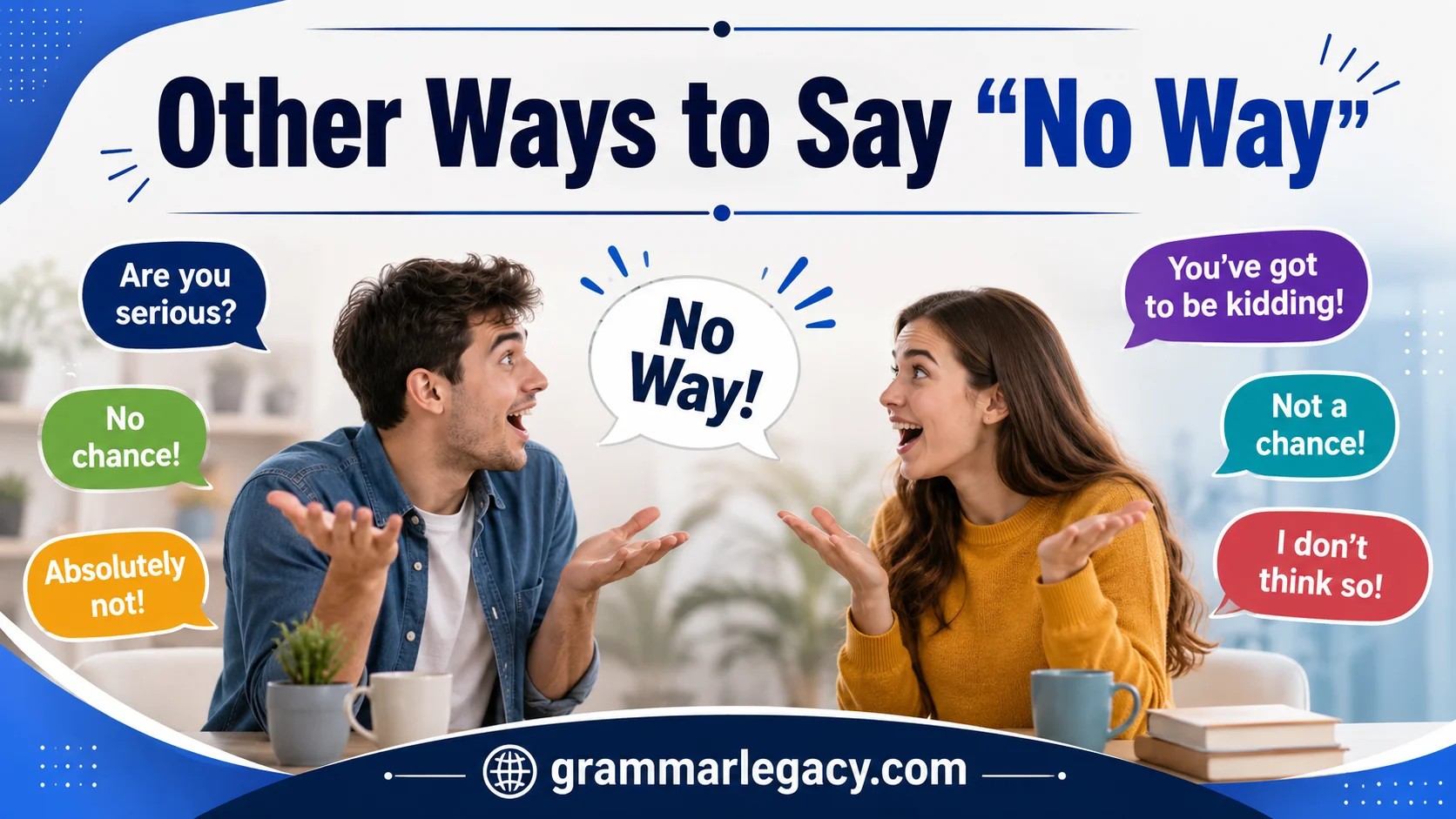

Other Ways to Say “No Way” can help you express disbelief, surprise, or a polite refusal in a more natural and engaging way. Instead of repeating the same phrase, using different formal, casual, and professional alternatives makes your English sound more fluent. These expressions also help you match the right tone for conversations, emails, meetings, and everyday situations while communicating with confidence.
Learning different Other Ways to Say “No Way” improves your vocabulary and helps you sound more like a native English speaker. Whether you want to show shock, disagree respectfully, or refuse something firmly, the right expression makes your message clear and meaningful. This guide shares practical alternatives with examples, making it easier to choose the best phrase for every personal or professional conversation.
Did You Know About “No Way”?
The phrase “No Way” is one of the most commonly used expressions in English conversations. It is a flexible phrase that can have different meanings based on tone, facial expression, and context. For example, saying “No way!” with excitement can mean “I can’t believe it,” while saying it firmly can mean “Absolutely not.”
The expression is widely used in casual English, movies, television shows, and daily conversations. However, in professional or formal settings, people often choose more polite alternatives to express disagreement or refusal.
What Does “No Way” Mean?
“No Way” is an informal English expression used to show strong disagreement, disbelief, surprise, or refusal. The exact meaning depends on the situation and the speaker’s emotions.
When someone says “No Way,” they may mean “I cannot believe this,” “I strongly disagree,” “That is impossible,” or “I refuse to do that.” Understanding the context helps you know the intended meaning behind the phrase.
Professional or Polite Ways to Say “No Way”
In professional communication, saying “No Way” may sound too direct or informal. Instead, people often use more respectful expressions that maintain a positive tone.
Some professional alternatives include:
- I’m afraid that won’t be possible.
- Unfortunately, I cannot agree with that approach.
- That may not be the best option at this time.
- I don’t think that will work effectively.
- I would prefer a different solution.
These alternatives allow you to express disagreement while keeping conversations respectful and constructive.
“No Way” Synonyms
- Absolutely not
- Not a chance
- Impossible
- No chance
- Definitely not
- Never
- Not possible
- I don’t think so
- I refuse
- Over my dead body
- Are you serious?
- You must be joking
- You’re kidding
- I can’t believe it
- That’s unbelievable
- No kidding
- Not in a million years
- Forget it
- Not happening
- No way in the world
- You wish
- Don’t even think about it
- That’s out of the question
- I highly doubt it
- There’s no way
- That can’t be true
- I disagree
- I don’t buy it
- That’s impossible to accept
- Absolutely impossible
1. Absolutely Not
Definition: “Absolutely not” is a strong and clear expression used to completely reject an idea, request, or suggestion. It shows firm disagreement or refusal without leaving room for misunderstanding.
Meanings: The phrase means “definitely no,” “certainly not,” or “I completely disagree.” It is stronger than a simple “no” because it shows confidence and certainty.
Example: “I asked him if he would share his private information, and he said, ‘Absolutely not.’”
Detailed Explanation: “Absolutely not” is commonly used when someone wants to make their refusal very clear. It can be used in both personal and professional conversations, depending on the tone. In a workplace setting, it may sound firm but respectful if used carefully. In casual conversations, it can show strong emotions or confidence about a decision. The phrase is useful when there is no possibility of changing someone’s mind.
Tone: Firm, confident, direct
Best use: Use it when you want to strongly reject something in a clear way.
2. Not a Chance
Definition: “Not a chance” is an informal expression used to show that something is very unlikely or completely impossible. It communicates strong refusal or disbelief in a casual way.
Meanings: The phrase means “there is no possibility,” “never,” or “that will not happen.” It is often used in everyday conversations with friends or family.
Example: “Do you think I’ll wake up at 5 a.m. on vacation? Not a chance!”
Detailed Explanation: “Not a chance” is a popular conversational phrase that expresses certainty that something will not happen. It often carries a relaxed or humorous feeling, especially among friends. The expression can also show confidence when someone believes a situation is impossible. While it is suitable for casual conversations, it may not be appropriate for formal business communication.
Tone: Casual, confident, sometimes humorous
Best use: Use it with friends, family, or in informal situations.
3. Impossible
Definition: “Impossible” describes something that cannot happen or cannot be accepted as realistic. It is a simple but powerful way to express disbelief or rejection.
Meanings: The word means “cannot happen,” “cannot be done,” or “not achievable.” It can express doubt, surprise, or refusal.
Example: “Finishing that huge project in one day is impossible.”
Detailed Explanation: “Impossible” is a versatile word that works in many situations. It can describe a difficult task, an unbelievable event, or a situation that someone refuses to believe. The meaning depends on the speaker’s intention and tone. In professional communication, it can be softened by adding phrases like “seems impossible” or “may not be realistic.”
Tone: Serious, doubtful, strong
Best use: Use it when something seems unrealistic or cannot happen.
4. No Chance
Definition: “No Chance” is an expression used to show that something is impossible or very unlikely to happen. It communicates strong doubt, refusal, or rejection in a simple way.
Meanings: The phrase means “there is no possibility,” “not possible,” or “there is no opportunity for this to happen.” It is commonly used in everyday conversations to express certainty.
Example: “Do you think he will change his mind after that argument?” “No chance. He has already made his decision.”
Detailed Explanation: “No Chance” is a common alternative to “No Way” when someone wants to express that something is unlikely or completely impossible. It can be used in casual conversations, friendly discussions, and even sports or competitive situations. The phrase often shows confidence in a person’s opinion or prediction. However, in formal situations, a softer expression may sound more respectful.
Tone: Casual, confident, doubtful
Best use: Use it when you strongly believe something will not happen.
5. Definitely Not
Definition: “Definitely Not” is a strong expression used to clearly reject an idea, request, or possibility. It shows complete certainty that the answer is negative.
Meanings: The phrase means “certainly not,” “without any doubt, no,” or “I completely disagree.” It emphasizes a firm decision.
Example: “Would you ever share your password with someone else?” “Definitely not.”
Detailed Explanation: “Definitely Not” is useful when you want to make your position clear and avoid confusion. It is stronger than simply saying “no” because it shows confidence and certainty. This phrase works well in both personal and professional situations when used with the right tone. It can express boundaries, opinions, or strong disagreement.
Tone: Firm, confident, clear
Best use: Use it when you want to give a strong and certain refusal.
6. Never
Definition: “Never” is a powerful word used to say that something will not happen at any time. It expresses a complete rejection of a possibility.
Meanings: The word means “not ever,” “at no time,” or “under no circumstances.” It can show strong feelings, determination, or refusal.
Example: “I will never give up on my dreams.”
Detailed Explanation: “Never” is one of the strongest alternatives to “No Way” because it removes any possibility of change. People often use it when expressing personal beliefs, promises, or strong decisions. It can sound emotional depending on the situation. In friendly conversations, it may show confidence, while in serious discussions, it can show determination.
Tone: Strong, emotional, determined
Best use: Use it when you mean something will absolutely not happen.
7. Not Possible
Definition: “Not Possible” is a phrase used to explain that something cannot happen or cannot be completed. It expresses that a situation is unrealistic or unavailable.
Meanings: The phrase means “cannot be done,” “unavailable,” or “there is no way to achieve it.” It is often used in practical situations.
Example: “Completing this entire project within one hour is not possible.”
Detailed Explanation: “Not Possible” is a more neutral alternative to “No Way.” It focuses less on emotions and more on facts, limitations, or realistic conditions. This phrase is commonly used in workplaces, planning discussions, and problem-solving conversations. It allows someone to explain that a request cannot be fulfilled without sounding too harsh.
Tone: Professional, practical, realistic
Best use: Use it when explaining limitations or restrictions.
8. I Don’t Think So
Definition: “I Don’t Think So” is a polite expression used to disagree or show doubt about something. It is a softer alternative to directly saying “No Way.”
Meanings: The phrase means “I disagree,” “probably not,” or “I don’t believe that is true.” It expresses uncertainty or a different opinion.
Example: “Do you think this plan will work without any changes?” “I don’t think so.”
Detailed Explanation: “I Don’t Think So” is a useful phrase when you want to disagree without sounding rude or aggressive. It is commonly used in everyday English because it keeps conversations friendly. Unlike stronger expressions such as “absolutely not,” this phrase leaves room for discussion. It is especially helpful when sharing opinions or politely refusing suggestions.
Tone: Polite, gentle, uncertain
Best use: Use it when you want to disagree in a respectful way.
9. I Refuse
Definition: “I Refuse” is a direct expression used when someone strongly rejects a request or demand. It shows a clear decision not to do something.
Meanings: The phrase means “I will not do this,” “I reject this request,” or “I choose not to accept.”
Example: “I refuse to participate in something that goes against my values.”
Detailed Explanation: “I Refuse” is stronger and more serious than many other alternatives to “No Way.” It is often used when someone wants to protect their rights, values, or personal boundaries. The phrase can sound powerful, but depending on the situation, it may also sound confrontational. Choosing a softer version can be better in polite conversations.
Tone: Strong, serious, determined
Best use: Use it when you need to clearly reject something important.
10. Over My Dead Body
Definition: “Over My Dead Body” is an emotional expression used to show extreme refusal. It means someone strongly opposes something and will not allow it easily.
Meanings: The phrase means “absolutely not,” “never,” or “I will strongly resist this.” It is usually dramatic and not meant literally.
Example: “Are you going to sell your childhood home?” “Over my dead body!”
Detailed Explanation: “Over My Dead Body” is an idiomatic expression often used for dramatic effect. People commonly say it in movies, stories, or casual conversations to show strong emotions. Although it sounds intense, it is usually a playful or exaggerated way of refusing something. It should be avoided in formal situations because it can sound too emotional.
Tone: Dramatic, emotional, humorous
Best use: Use it in informal situations when expressing strong opposition.
11. Are You Serious?
Definition: “Are You Serious?” is an expression used to show surprise, disbelief, or doubt about something someone has said. It is often used when information sounds unexpected or difficult to believe.
Meanings: The phrase means “Do you really mean that?” “Is that true?” or “I cannot believe what I just heard.” It can express shock, excitement, or confusion.
Example: “You won the competition in first place.” “Are you serious? That’s amazing!”
Detailed Explanation: “Are You Serious?” is a flexible alternative to “No Way” because it often shows disbelief rather than direct refusal. People use it when they hear surprising news, unexpected information, or something that seems impossible. The meaning depends heavily on tone and facial expression. A cheerful tone shows excitement, while a serious tone may show doubt or disagreement.
Tone: Surprised, curious, emotional
Best use: Use it when reacting to surprising or unbelievable information.
12. You Must Be Joking
Definition: “You Must Be Joking” is a phrase used when someone believes something sounds unbelievable or ridiculous. It shows that the speaker finds something hard to accept.
Meanings: The phrase means “You cannot be serious,” “That cannot be true,” or “You are probably joking.”
Example: “You have to work for 20 hours today.” “You must be joking!”
Detailed Explanation: “You Must Be Joking” is a common conversational phrase that expresses surprise, disbelief, or humor. It is often used among friends, family members, and coworkers in informal situations. The phrase does not always mean the speaker thinks someone is actually making a joke. Sometimes it simply shows that the information feels unbelievable. In professional conversations, a softer expression may be more appropriate.
Tone: Surprised, playful, doubtful
Best use: Use it when something sounds unbelievable or unexpected.
13. You’re Kidding
Definition: “You’re Kidding” is an informal expression used to show surprise or disbelief. It suggests that the speaker cannot believe what they have heard.
Meanings: The phrase means “You are joking,” “That cannot be true,” or “I do not believe it.”
Example: “You got a free ticket to the concert?” “You’re kidding! That’s incredible.”
Detailed Explanation: “You’re Kidding” is a friendly and casual way to react to surprising information. It is commonly used in everyday conversations and social situations. Depending on the speaker’s tone, it can express excitement, doubt, or even disappointment. This phrase creates a natural and emotional connection during conversations because it shows a strong reaction.
Tone: Casual, friendly, surprised
Best use: Use it with friends, family, or informal conversations.
14. I Can’t Believe It
Definition: “I Can’t Believe It” is an expression used to show strong surprise or disbelief. It communicates that something feels unexpected or impossible to accept.
Meanings: The phrase means “This is unbelievable,” “I am shocked,” or “I did not expect this.”
Example: “I can’t believe it! You finally achieved your goal.”
Detailed Explanation: “I Can’t Believe It” is often used as an emotional response rather than a direct refusal. It can express happiness, shock, disappointment, or amazement depending on the situation. This phrase is popular in daily English because it allows speakers to show their feelings naturally. It is especially useful when reacting to surprising news or events.
Tone: Emotional, surprised, expressive
Best use: Use it when something feels unexpected or shocking.
15. That’s Unbelievable
Definition: “That’s Unbelievable” is a phrase used to describe something extremely surprising or difficult to accept. It expresses a strong reaction to unexpected information.
Meanings: The phrase means “That is hard to believe,” “That is amazing,” or “That seems impossible.”
Example: “Your team finished the project in one day? That’s unbelievable!”
Detailed Explanation: “That’s Unbelievable” can have both positive and negative meanings. It may show admiration when something impressive happens, or it may show disbelief when something seems impossible. The speaker’s tone helps listeners understand the intended meaning. This expression is common in conversations, entertainment, and storytelling.
Tone: Amazed, shocked, emotional
Best use: Use it when reacting strongly to surprising situations.
Read More: 30 Other Ways to Say “Rest in Peace” (With Examples)
16. No Kidding
Definition: “No Kidding” is an informal phrase used to show surprise, agreement, or confirmation. It can also mean that something is genuinely true.
Meanings: The phrase means “Really?” “Seriously?” or “I agree, that is surprising.”
Example: “I spent five hours waiting in line.” “No kidding! That’s a long time.”
Detailed Explanation: “No Kidding” is a casual expression that can replace “No Way” when showing surprise or disbelief. It is commonly used in relaxed conversations and often creates a friendly atmosphere. Unlike stronger negative expressions, it does not always mean rejection. Instead, it shows that the speaker finds something surprising or agrees with a statement.
Tone: Casual, friendly, surprised
Best use: Use it during informal conversations to show reaction or agreement.
17. Not In a Million Years
Definition: “Not In a Million Years” is a strong expression used to say that something will never happen. It emphasizes complete refusal or impossibility.
Meanings: The phrase means “never,” “absolutely not,” or “there is no possibility.”
Example: “Would you ever give up your dream?” “Not in a million years.”
Detailed Explanation: “Not In a Million Years” is a dramatic alternative to “No Way.” It is often used when someone wants to show strong feelings, determination, or complete disagreement. The phrase is usually not literal but is used to emphasize how unlikely something is. It works well in emotional conversations and storytelling.
Tone: Dramatic, determined, emotional
Best use: Use it when expressing an extremely strong refusal.
18. Forget It
Definition: “Forget It” is an expression used to reject an idea, request, or possibility. It can show that someone does not want to continue discussing something.
Meanings: The phrase means “do not consider it,” “leave it alone,” or “there is no point.”
Example: “Can I convince you to change your decision?” “Forget it. My mind is made up.”
Detailed Explanation: “Forget It” can have different meanings depending on tone. In a friendly conversation, it may simply mean not to worry about something. In a stronger tone, it can express refusal or frustration. Because it can sound dismissive, it should be used carefully in professional situations.
Tone: Casual, dismissive, firm
Best use: Use it in informal situations when rejecting an idea or ending a discussion.
19. Not Happening
Definition: “Not Happening” is an informal expression used to show that something will not take place or will not be accepted. It communicates a clear refusal or rejection of an idea.
Meanings: The phrase means “it will not happen,” “I will not agree,” or “there is no possibility of this happening.”
Example: “Are you going to let him borrow your new car?” “Not happening.”
Detailed Explanation: “Not Happening” is a casual alternative to “No Way” that shows strong disagreement or refusal. It is commonly used when someone wants to quickly reject a suggestion or request. The phrase often appears in everyday conversations, social media, and informal speech. Although it is clear and direct, it may sound too casual for professional communication.
Tone: Casual, confident, firm
Best use: Use it when rejecting an idea in informal conversations.
20. No Way in the World
Definition: “No Way in the World” is a stronger version of “No Way” used to express complete disbelief or refusal. It emphasizes that something is absolutely impossible.
Meanings: The phrase means “under no circumstances,” “absolutely not,” or “there is no possibility at all.”
Example: “Would you ever leave your family behind?” “No way in the world.”
Detailed Explanation: “No Way in the World” adds extra emphasis to a normal refusal. It is often used when someone wants to make their feelings extremely clear. The phrase can express strong emotions, personal values, or complete disagreement. It is more dramatic than simple alternatives and is usually used in personal conversations rather than formal writing.
Tone: Strong, emotional, dramatic
Best use: Use it when you want to emphasize complete refusal.
21. You Wish
Definition: “You Wish” is an informal expression used to reject someone’s expectation or suggestion. It often shows confidence, teasing, or disagreement.
Meanings: The phrase means “that will not happen,” “keep dreaming,” or “you are hoping for something impossible.”
Example: “You think I’ll give you the last piece of cake?” “You wish!”
Detailed Explanation: “You Wish” is usually used in playful or humorous conversations. It can be a fun way to say “No Way” without sounding too serious. However, depending on the tone, it may sound sarcastic or slightly rude. This phrase is common among friends and people who have a comfortable relationship.
Tone: Playful, teasing, sarcastic
Best use: Use it with friends or in humorous situations.
22. Don’t Even Think About It
Definition: “Don’t Even Think About It” is a strong expression used to warn someone not to consider doing something. It shows clear rejection and strong disagreement.
Meanings: The phrase means “do not consider it,” “absolutely not,” or “do not try that.”
Example: “Can I take your favorite jacket without asking?” “Don’t even think about it.”
Detailed Explanation: “Don’t Even Think About It” is a powerful alternative to “No Way” because it prevents an idea before it is even discussed. People often use it when setting boundaries or making their position clear. It can sound serious, but it can also be used jokingly between close friends. The meaning depends greatly on the relationship and tone.
Tone: Firm, protective, serious
Best use: Use it when strongly stopping an unwanted action or idea.
23. That’s Out of the Question
Definition: “That’s Out of the Question” is a phrase used to say that something is not possible or will not be considered. It expresses a firm decision or refusal.
Meanings: The phrase means “not acceptable,” “not possible,” or “not something we will discuss.”
Example: “Can we ignore the safety rules just this once?” “No, that’s out of the question.”
Detailed Explanation: “That’s Out of the Question” is a more formal alternative to “No Way.” It is often used in professional, family, and serious discussions. The phrase shows that a particular option has already been rejected. It sounds more polite than a direct refusal while still communicating a strong boundary.
Tone: Formal, firm, professional
Best use: Use it in serious discussions or professional settings.
24. I Highly Doubt It
Definition: “I Highly Doubt It” is an expression used to show strong uncertainty or disbelief. It suggests that something is very unlikely to happen.
Meanings: The phrase means “I do not think that is true,” “probably not,” or “I have serious doubts.”
Example: “Do you think they will finish everything before the deadline?” “I highly doubt it.”
Detailed Explanation: “I Highly Doubt It” is a softer alternative to “No Way” because it expresses an opinion rather than an absolute refusal. It is useful when someone wants to disagree while leaving room for discussion. This phrase is common in workplace conversations, predictions, and everyday communication. It sounds more thoughtful and less aggressive than stronger expressions.
Tone: Polite, doubtful, reasonable
Best use: Use it when expressing strong doubt without sounding harsh.
25. There’s No Way
Definition: “There’s No Way” is one of the closest alternatives to the phrase “No Way.” It expresses disbelief, refusal, or the idea that something cannot happen.
Meanings: The phrase means “it is impossible,” “I do not believe it,” or “I strongly disagree.”
Example: “There’s no way he completed that difficult task alone.”
Detailed Explanation: “There’s No Way” is widely used in spoken English because it works in many situations. It can show surprise when hearing unbelievable news or refusal when rejecting an idea. The phrase is flexible and depends on the speaker’s emotions. It can be casual, serious, or emotional depending on the context.
Tone: Flexible, emotional, conversational
Best use: Use it in everyday conversations for disbelief or refusal.
26. That Can’t Be True
Definition: “That Can’t Be True” is an expression used when someone finds information difficult to believe. It shows surprise, doubt, or disbelief about a statement or situation.
Meanings: The phrase means “I don’t believe this,” “this seems impossible,” or “I think this information may be incorrect.”
Example: “You finished the entire book in one hour?” “That can’t be true!”
Detailed Explanation: “That Can’t Be True” is a natural alternative to “No Way” when someone reacts to unexpected news or information. It does not always mean the speaker is rejecting the idea completely. Instead, it often shows that the person needs more proof or explanation. This expression is common in daily conversations, storytelling, and moments of surprise. It helps speakers express emotions clearly without sounding too aggressive.
Tone: Surprised, doubtful, emotional
Best use: Use it when something sounds unbelievable or unexpected.
27. I Disagree
Definition: “I Disagree” is a polite expression used to show that someone has a different opinion or viewpoint. It is a respectful alternative to directly saying “No Way.”
Meanings: The phrase means “I do not share the same opinion,” “I have a different view,” or “I do not accept that idea.”
Example: “I think this is the only solution to the problem.” “I disagree. We should consider other options.”
Detailed Explanation: “I Disagree” is commonly used in professional and formal conversations where respectful communication is important. Unlike emotional expressions such as “Absolutely not,” this phrase focuses on differences in opinions rather than personal rejection. It allows people to have constructive discussions while maintaining respect. This makes it a useful phrase for meetings, debates, and thoughtful conversations.
Tone: Professional, respectful, calm
Best use: Use it when politely expressing a different opinion.
28. I Don’t Buy It
Definition: “I Don’t Buy It” is an informal expression used when someone does not believe a statement or explanation. It shows doubt or suspicion about something.
Meanings: The phrase means “I do not believe it,” “I am not convinced,” or “that explanation does not seem true.”
Example: “He said he forgot about the meeting again.” “I don’t buy it.”
Detailed Explanation: “I Don’t Buy It” is a conversational phrase that expresses disbelief in a casual way. It is often used when someone thinks an explanation is not honest or convincing. The phrase is common in everyday English, movies, and informal discussions. Because it can sound skeptical or critical, it should be used carefully when speaking with people you do not know well.
Tone: Skeptical, casual, doubtful
Best use: Use it when you do not believe someone’s explanation or claim.
29. That’s Impossible to Accept
Definition: “That’s Impossible to Accept” is a phrase used when someone strongly rejects an idea, situation, or decision. It expresses serious disagreement based on personal values or circumstances.
Meanings: The phrase means “I cannot agree with this,” “I cannot tolerate this,” or “this is not acceptable.”
Example: “Treating people unfairly is impossible to accept.”
Detailed Explanation: “That’s Impossible to Accept” is a more serious and formal alternative to “No Way.” It is often used when discussing important issues, ethical concerns, or strong personal beliefs. Unlike casual expressions, this phrase explains that the problem is not just surprising but unacceptable. It works well in professional discussions, social topics, and situations requiring a strong position.
Tone: Serious, formal, principled
Best use: Use it when rejecting something because it conflicts with values or standards.
30. Absolutely Impossible
Definition: “Absolutely Impossible” is a powerful expression used to describe something that cannot happen under any circumstances. It shows complete certainty and strong disbelief.
Meanings: The phrase means “completely impossible,” “there is no chance,” or “cannot happen at all.”
Example: “Finishing that amount of work in five minutes is absolutely impossible.”
Detailed Explanation: “Absolutely Impossible” is one of the strongest alternatives to “No Way.” It clearly communicates that a situation cannot occur or cannot be accepted. This phrase is useful when explaining facts, limitations, or strong opinions. It can be used in both formal and informal conversations, depending on the situation. The expression adds emphasis and makes the speaker’s position very clear.
Tone: Strong, confident, certain
Best use: Use it when something is completely unrealistic or cannot happen.
FAQs:
1. What does “Other Ways to Say “No Way”” mean?
It refers to different words and phrases you can use instead of “No Way” to express disbelief, surprise, or refusal in a more natural and appropriate way.
2. When should I use alternatives to “No Way”?
You can use these alternatives in everyday conversations, emails, meetings, or professional settings, depending on the tone you want to create.
3. Are there formal alternatives to “No Way”?
Yes. Formal alternatives include phrases like “I’m afraid not,” “That won’t be possible,” and “Unfortunately, no.” These sound polite and professional.
4. Can I use “No Way” in professional communication?
Generally, “No Way” is too casual for the workplace. It is better to use polite alternatives that show respect while clearly expressing your response.
5. Why should I learn Other Ways to Say “No Way”?
Learning Other Ways to Say “No Way” expands your vocabulary, improves your communication skills, and helps you choose the right expression for different situations.
Conclusion:
Learning Other Ways to Say “No Way” allows you to communicate with greater confidence, clarity, and flexibility. Whether you want to express surprise, disbelief, or a polite refusal, using the right alternative helps your English sound more natural and professional. By understanding the tone and context of each expression, you can make stronger connections, avoid sounding repetitive, and respond appropriately in both personal and professional conversations.