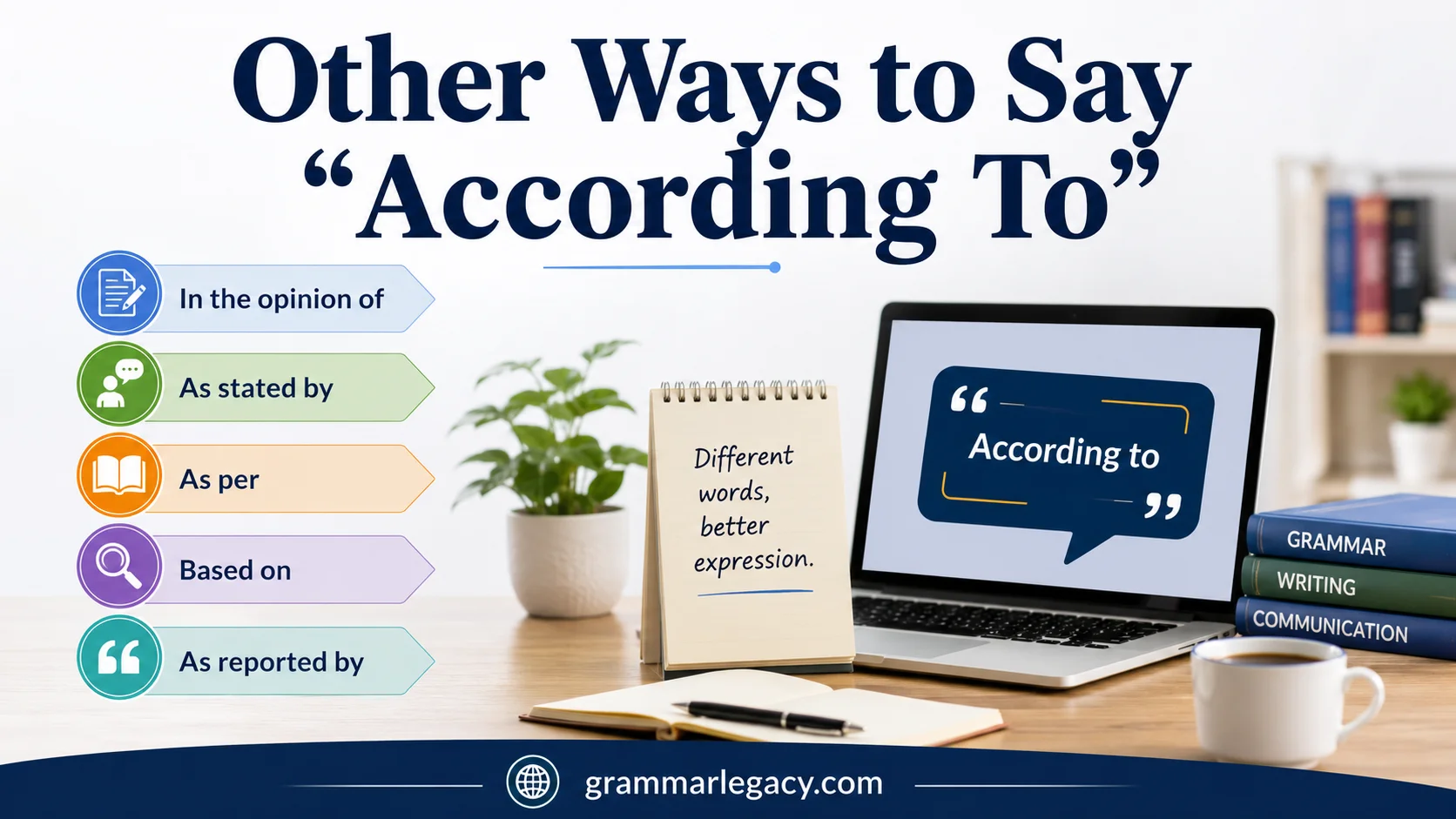

Other Ways to Say “According To” (With Examples) can improve your writing by helping you avoid repeating the same phrase. Whether you’re writing an email, essay, blog post, or business report, using different expressions makes your message more natural, clear, and professional. Learning these alternatives also strengthens your vocabulary, improves communication, and helps you reference a source with the right tone and confidence.
Choosing the best alternative depends on your audience and purpose. Formal, academic, and casual situations all require different wording to keep your writing engaging and precise. In this guide, you’ll discover useful alternatives, complete with examples, practical scenarios, and helpful tips to improve clarity, writing style, and overall English communication skills.
Did You Know About “According To”?
According to is one of the most common source-attribution phrases in English. It is often used to show where information came from, such as a person, a report, a study, a law, or a news outlet. It helps writers avoid sounding overly personal while giving credit to the original source.
It is also flexible. You can use according to in academic writing, journalism, business communication, and everyday speech. However, overusing it can make your writing repetitive, which is why having a strong list of according to synonyms is so helpful.
What Does “According To” Mean?
According to means “as stated by,” “as reported by,” or “in the view of” a source, person, or document. It introduces information that comes from somewhere else rather than from the speaker’s own opinion.
For example: According to the report, sales increased last quarter. This means the report is the source of the information.
In many cases, according to is used to show authority, evidence, or reference. It is especially common in formal writing, news writing, and professional communication.
Professional or Political Ways to Say “According To”
In professional, legal, or political writing, you may want alternatives that sound more official and objective. Strong options include in accordance with, as stated by, as reported by, on the authority of, per the findings of, and consistent with.
These phrases are useful when you want to sound precise, diplomatic, or institutionally aware. For example, a policy statement might say in accordance with the guidelines, while a press release may use as reported by the ministry. These alternatives help your writing feel more formal and credible.
“According To” Synonyms
1. As Per
2. In Accordance With
3. Based On
4. As Stated By
5. As Reported By
6. According to the Report
7. Per
8. In Line With
9. In Keeping With
10. Following
11. In the Words Of
12. Citing
13. From
14. On the Authority Of
15. As Outlined By
16. As Mentioned By
17. In View Of
18. By the Account Of
19. In Agreement With
20. In Compliance With
21. Consistent With
22. As Claimed By
23. As Explained By
24. As Noted By
25. As Described By
26. In the Estimation Of
27. By Reference To
28. Under
29. By Instruction Of
30. From the Perspective Of
1. As Per
Definition: As per is a formal phrase used to show that something follows a source, instruction, or rule. It is common in business writing and official communication.
Meanings: It means “in line with” or “based on.”
Example: As per your request, we have updated the document.
Detailed Explanation: This phrase is widely used in professional emails, office messages, and corporate writing. It sounds neat, direct, and structured. People often use it when referring to instructions, schedules, agreements, or policies. Although it is formal, it is still simple and easy to understand. It is especially useful when you want your tone to be respectful and efficient.
Tone: Formal, professional, polite.
Best Use: Business emails, office notes, client communication.
2. In Accordance With
Definition: This phrase means that something matches a rule, law, instruction, or guideline. It is a very formal and precise expression.
Meanings: It means “following,” “matching,” or “consistent with.”
Example: In accordance with company policy, all leaves must be approved in advance.
Detailed Explanation: This expression is excellent for legal, academic, and administrative writing. It gives your sentence an authoritative and disciplined feel. People often use it when discussing laws, procedures, and regulations. It shows that an action was done properly and within accepted limits. Because of its formal tone, it is less common in casual speech.
Tone: Very formal, legal, official.
Best Use: Policies, contracts, legal documents, formal reports.
3. Based On
Definition: This phrase shows that something is built from, derived from, or supported by information. It is one of the most natural alternatives to according to.
Meanings: It means “using as a foundation” or “from evidence.”
Example: Based on the survey results, customers prefer faster delivery.
Detailed Explanation: This phrase is very common in everyday writing, academic work, and professional communication. It sounds natural and clear without being too stiff. Writers use it when explaining that an opinion, conclusion, or decision comes from evidence or data. It works well in blogs, articles, presentations, and research summaries. If you want a simple and modern substitute, this is one of the best choices.
Tone: Neutral, professional, clear.
Best Use: Reports, blogs, research, presentations.
4. As Stated By
Definition: This phrase means something was expressed directly by a person or source. It is useful when quoting or paraphrasing information.
Meanings: It means “as said by” or “as mentioned by.”
Example: As stated by the manager, the meeting will begin at 10 a.m.
Detailed Explanation: This phrase gives a sentence a clean and formal structure. It is especially useful when you want to reference a speaker, expert, or official source without using direct quotation. It also works well in professional summaries and journalistic writing. The phrase sounds accurate and calm, which makes it useful in serious contexts. It can help you avoid repetition while keeping your sentence trustworthy.
Tone: Formal, factual, respectful.
Best Use: Interviews, reports, news, business writing.
5. As Reported By
Definition: This phrase indicates that information comes from a news outlet, source, or reporter. It is commonly used in journalism and media writing.
Meanings: It means “as covered by” or “as disclosed by.”
Example: As reported by the newspaper, inflation has slowed this month.
Detailed Explanation: This is one of the strongest alternatives when you want to sound journalistic. It clearly shows that the information comes from a reporting source rather than personal opinion. Writers use it in articles, blogs, and summaries of current events. It also helps readers understand that the claim is being attributed, not invented. This phrase is especially useful when you cite media coverage or public statements.
Tone: Journalistic, objective, formal.
Best Use: News writing, blog reporting, public updates.
6. According To The Report
Definition: This phrase points specifically to a written report as the source of information. It is clear, formal, and easy to understand.
Meanings: It means “as the report says.”
Example: According to the report, unemployment has decreased by 2%.
Detailed Explanation: This phrase works well when you want to mention a document directly and avoid sounding vague. It is useful in business, research, policy, and educational writing. Because it names the source clearly, it adds structure and credibility to your sentence. It also helps the reader know exactly where the information came from. This is a strong choice when referencing official findings or published results.
Tone: Formal, factual, informative.
Best Use: Reports, studies, statistics, business analysis.
7. Per
Definition: Per is a short formal word meaning “according to” or “as stated in.” It is often used in business and legal writing.
Meanings: It means “in line with” or “based on.”
Example: Per the contract, payment is due within 30 days.
Detailed Explanation: This is a compact and efficient alternative that appears often in professional documents. It saves space and sounds polished, especially in writing where brevity matters. However, it can feel a little stiff or corporate if used too often. It is best when you need a concise phrase that still sounds formal. Many people use it in memos, invoices, policies, and workplace communication.
Tone: Formal, brief, corporate.
Best Use: Contracts, office writing, business documents.
8. In Line With
Definition: This phrase means that something agrees with or follows a rule, idea, or source. It is a useful modern alternative to according to.
Meanings: It means “consistent with” or “matching.”
Example: In line with the new policy, all staff must wear badges.
Detailed Explanation: This expression is smooth, professional, and widely accepted in both formal and semi-formal writing. It is often used when describing decisions, actions, or statements that match expectations or standards. The phrase works well in business, education, and public communication. It also has a slightly softer tone than some legal expressions. That makes it flexible for many different contexts.
Tone: Professional, balanced, modern.
Best Use: Workplace communication, policy updates, announcements.
9. In Keeping With
Definition: This phrase means something is consistent with a style, rule, tradition, or source. It often has a slightly elegant or literary feel.
Meanings: It means “in harmony with” or “fitting with.”
Example: In keeping with tradition, the ceremony began at sunrise.
Detailed Explanation: This alternative is helpful when discussing customs, style, values, or established patterns. It is less direct than according to, but it carries a graceful tone. Writers often use it in essays, descriptions, and culturally sensitive writing. It can also make a sentence feel thoughtful and well-shaped. If you want a phrase that sounds polished but not too rigid, this is a strong choice.
Tone: Elegant, formal, thoughtful.
Best Use: Essays, traditions, cultural writing, polished prose.
10. Following
Definition: This phrase shows that something comes after or is based on a source, event, or instruction. It is simple and widely used.
Meanings: It means “after” or “as a result of.”
Example: Following the announcement, the team held a brief meeting.
Detailed Explanation: This word can work as a substitute for according to when you want to emphasize sequence or response. It is especially useful in business, news, and formal writing. It creates a sense of order and progression in the sentence. Unlike some other alternatives, it sounds clean and natural in modern English. It is a helpful option when discussing events, updates, and next steps.
Tone: Neutral, professional, clear.
Best Use: Announcements, timelines, news updates.
11. In The Words Of
Definition: This phrase is used when repeating or paraphrasing someone’s exact style of expression. It gives a personal or quoted feel.
Meanings: It means “as said by” or “using someone’s own wording.”
Example: In the words of the author, “simplicity is the ultimate sophistication.”
Detailed Explanation: This phrase is especially effective when the speaker’s voice matters. It can make a sentence feel more vivid, human, and memorable. Writers often use it in speeches, essays, creative writing, and profiles. It works well when you want to honor the original voice of a person or source. Because it feels more expressive, it is a great choice for storytelling and commentary.
Tone: Expressive, respectful, literary.
Best Use: Speeches, essays, quotes, creative writing.
12. Citing
Definition: Citing means referring to a source of information, evidence, or authority. It is a very useful word in academic and formal writing.
Meanings: It means “referencing” or “mentioning as evidence.”
Example: Citing recent research, the professor explained the trend.
Detailed Explanation: This word is especially important in scholarly writing, journalism, and legal or research-based contexts. It shows that a fact, argument, or claim is backed by evidence. Using citing can make your writing sound more informed and responsible. It also helps readers see that your point is supported by a reliable source. This is a strong choice when precision and credibility matter.
Tone: Academic, formal, credible.
Best Use: Research papers, articles, essays, analytical writing.
13. From
Definition: This simple word can indicate the origin of information or a source. It is often used with reports, studies, or people.
Meanings: It means “coming out of” or “originating with.”
Example: The data from the survey shows strong support.
Detailed Explanation: While from is not always a direct substitute, it works well when the source is already clear in the sentence. It keeps writing natural, simple, and smooth. Many writers prefer it because it sounds less formal than according to but still points to a source. It is useful in both spoken and written English. When you want a light, modern tone, this option works beautifully.
Tone: Neutral, simple, natural.
Best Use: Everyday writing, summaries, casual professional text.
14. On The Authority Of
Definition: This phrase means that information is supported or approved by an authoritative source. It is highly formal and often serious in tone.
Meanings: It means “with the approval of” or “based on official authority.”
Example: On the authority of the director, the deadline has been extended.
Detailed Explanation: This expression sounds official and weighty, making it ideal for legal, government, and administrative writing. It suggests that the information is not just reported casually but has been backed by someone with power or responsibility. Because of its formality, it should be used carefully and only when the context truly calls for it. It gives a sentence strong institutional credibility. It is not a casual substitute, but it is very effective in the right setting.
Tone: Authoritative, formal, official.
Best Use: Government notices, legal statements, formal directives.
15. As Outlined By
Definition: This phrase means something has been described or arranged in detail by a source. It is useful for structured and professional writing.
Meanings: It means “as explained” or “as set out.”
Example: As outlined by the consultant, the strategy has three stages.
Detailed Explanation: This phrase is helpful when you want to reference a plan, framework, or explanation already provided by someone else. It works especially well in reports, strategy documents, and presentations. It gives your writing a sense of order and clarity. Readers can quickly understand that the source has already laid out the details. It is a polished phrase that fits formal business communication very well.
Tone: Professional, structured, precise.
Best Use: Plans, proposals, strategy documents, business reports.
Read More: 30 Other Ways to Say “You’re Welcome” (With Examples)
16. As Mentioned By
Definition: This phrase shows that a source has brought up the information previously. It is straightforward and easy to use.
Meanings: It means “as noted by” or “as said by.”
Example: As mentioned by the teacher, the test will be next Monday.
Detailed Explanation: This phrase is useful when you want to refer back to something already said or written. It is especially common in business writing, meeting notes, and discussions. The tone is polite and uncomplicated, which makes it flexible in many contexts. It is not as strong as some legal alternatives, but it is very practical. It helps you keep your writing connected and organized.
Tone: Neutral, polite, professional.
Best Use: Emails, notes, meeting summaries, reports.
17. In View Of
Definition: This phrase means considering a fact, source, or situation. It is often used in formal and analytical writing.
Meanings: It means “because of” or “taking into account.”
Example: In view of the new evidence, the committee changed its decision.
Detailed Explanation: This alternative is useful when the source or circumstance influences a result. It gives your sentence a thoughtful and measured tone. Writers often use it in essays, policy writing, and formal analysis. It suggests careful consideration rather than casual observation. If your goal is to sound reflective and professional, this phrase works very well.
Tone: Formal, analytical, considered.
Best Use: Policy writing, essays, formal reasoning.
18. By The Account Of
Definition: This phrase means that something is being told or described by a source or witness. It has a slightly narrative quality.
Meanings: It means “according to the story of” or “as told by.”
Example: By the account of the witness, the event lasted only a few minutes.
Detailed Explanation: This phrase works well in storytelling, interviews, and descriptive writing. It gives the sentence a human and observational tone. It is especially useful when presenting someone’s version of events. The phrase can make your writing feel more vivid and personal than a plain factual statement. It is best used where the source’s perspective matters.
Tone: Narrative, descriptive, formal.
Best Use: Stories, interviews, witness accounts, feature writing.
19. In Agreement With
Definition: This phrase shows that something matches or supports a source, rule, or statement. It is a clear formal alternative.
Meanings: It means “consistent with” or “in line with.”
Example: The findings are in agreement with previous studies.
Detailed Explanation: This phrase is especially useful in academic, scientific, and professional writing. It signals harmony between different facts, ideas, or results. Writers use it when comparing evidence or showing that one source supports another. It creates a calm, balanced tone and feels objective. This makes it a strong substitute when you want to keep your writing precise and credible.
Tone: Academic, formal, objective.
Best Use: Research, analysis, comparisons, reports.
20. In Compliance With
Definition: This phrase means that something follows a rule, law, request, or standard. It is very formal and policy-oriented.
Meanings: It means “obedient to” or “following.”
Example: The company acted in compliance with safety regulations.
Detailed Explanation: This phrase is ideal for legal, business, and administrative contexts. It emphasizes that a person or organization is respecting a requirement or standard. It is often used in audits, policy statements, and official documents. The wording feels strict, precise, and trustworthy. It is a strong choice when you need to show discipline and responsibility in writing.
Tone: Formal, regulated, official.
Best Use: Compliance reports, legal writing, safety documents.
21. Consistent With
Definition: This phrase means that something matches or agrees with another fact or source. It is widely used in academic and professional writing.
Meanings: It means “in harmony with” or “not conflicting with.”
Example: The results are consistent with earlier findings.
Detailed Explanation: This phrase is excellent when comparing evidence, ideas, or statements. It is more analytical than emotional, which makes it especially useful in research and business contexts. The phrase helps readers see that different points support each other. It also sounds polished without being overly formal. Writers often choose it when they want to show evidence-based agreement.
Tone: Analytical, professional, neutral.
Best Use: Research papers, scientific writing, reports.
22. As Claimed By
Definition: This phrase means that a statement comes from someone who is making a claim. It is useful when the information has not been fully verified.
Meanings: It means “as said by” or “as asserted by.”
Example: As claimed by the company, the product is completely recyclable.
Detailed Explanation: This phrase is especially useful when you want to stay careful or neutral. It tells the reader that the statement belongs to the source, not necessarily to the writer. That makes it helpful in reporting, criticism, and balanced discussion. It can also show a small degree of distance or caution. This is a smart choice when you need to attribute a claim without fully endorsing it.
Tone: Neutral, cautious, objective.
Best Use: News writing, reviews, analytical commentary.
23. As Explained By
Definition: This phrase means that a source has provided a reason, interpretation, or clarification. It is useful when the source is teaching or clarifying something.
Meanings: It means “as clarified by” or “as described by.”
Example: As explained by the doctor, the treatment takes time to work.
Detailed Explanation: This phrase is helpful when the source is giving context or meaning, not just stating facts. It is common in education, interviews, customer communication, and professional guidance. The wording feels clear and respectful, making it suitable for informative writing. It also helps the writer sound careful and attentive to detail. This is a strong option when you need to emphasize understanding.
Tone: Clear, explanatory, respectful.
Best Use: Guides, interviews, teaching, professional explanations.
24. As Noted By
Definition: This phrase means that a source has observed, mentioned, or pointed out something. It sounds formal and polished.
Meanings: It means “as observed by” or “as mentioned by.”
Example: As noted by the analyst, consumer demand is rising.
Detailed Explanation: This is a smooth and professional phrase that works well in reports and articles. It is often used when summarizing a source’s observation without quoting directly. The tone is thoughtful and controlled, which makes it useful in serious writing. It can also help you avoid repeating according to too often. Many writers like it because it sounds elegant and concise.
Tone: Formal, polished, observant.
Best Use: Reports, analysis, summaries, articles.
25. As Described By
Definition: This phrase means that a source has explained or portrayed something in a certain way. It is useful for details and characterization.
Meanings: It means “as portrayed by” or “as explained by.”
Example: As described by the traveler, the city was peaceful and vibrant.
Detailed Explanation: This phrase works especially well when the source is describing an experience, setting, or situation. It gives your writing a descriptive and sometimes personal feel. It is useful in storytelling, interviews, reviews, and travel writing. The phrase shows that the information comes from the source’s description rather than the writer’s direct observation. It adds color while still keeping proper attribution.
Tone: Descriptive, thoughtful, moderate.
Best Use: Travel writing, interviews, profiles, storytelling.
26. In The Estimation Of
Definition: This phrase means “in the opinion of” or “based on the judgment of” a source. It is formal and slightly intellectual.
Meanings: It means “as judged by” or “from the view of.”
Example: In the estimation of many experts, the policy needs revision.
Detailed Explanation: This expression is useful when the source is giving a judgment rather than a hard fact. It often appears in formal essays, commentary, and analytical writing. The phrase sounds thoughtful and measured, which helps create a sophisticated tone. It is especially effective when discussing opinions from experts, analysts, or leaders. If you want a refined alternative, this is a strong choice.
Tone: Formal, intellectual, measured.
Best Use: Opinion pieces, analysis, expert commentary.
27. By Reference To
Definition: This phrase means that something is explained or supported using a source, example, or standard. It is formal and technical.
Meanings: It means “with reference to” or “by pointing to.”
Example: The issue was resolved by reference to the original agreement.
Detailed Explanation: This phrase is useful in academic, legal, and technical writing. It gives your sentence a careful and structured feel. Writers use it when they want to show that a conclusion or explanation is linked to a specific source. It can sound more complex than ordinary English, so it works best in formal contexts. It is a precise choice when exact referencing matters.
Tone: Formal, technical, precise.
Best Use: Legal writing, academic discussion, technical explanation.
28. Under
Definition: This short preposition can indicate that something falls within the guidance of a rule, authority, or document. It is common in formal English.
Meanings: It means “according to the rule of” or “within the scope of.”
Example: Under the new law, smoking is prohibited in public parks.
Detailed Explanation: This is a very useful and concise alternative when referring to laws, policies, or systems. It is not always a direct replacement, but in the right context it works beautifully. It gives the sentence a legal or procedural tone without sounding wordy. It is especially effective when the rule itself is the focus. Because it is short and strong, it helps keep formal writing tight and readable.
Tone: Formal, legal, concise.
Best Use: Laws, regulations, official rules, policies.
29. By Instruction Of
Definition: This phrase means that an action was done because someone gave an instruction or order. It is formal and authoritative.
Meanings: It means “on the direction of” or “as ordered by.”
Example: The file was sent by instruction of the supervisor.
Detailed Explanation: This phrase is especially useful in administrative, legal, and organizational writing. It shows that the source of the action was a direct instruction from someone in authority. The tone is official and controlled, which makes it appropriate for internal communication and formal records. It can also help avoid ambiguity about who directed the action. This is a powerful phrase when hierarchy matters.
Tone: Official, authoritative, formal.
Best Use: Internal memos, administrative notes, formal records.
30. From The Perspective Of
Definition: This phrase shows that information is being viewed through someone’s point of view. It is thoughtful and often used in analysis.
Meanings: It means “in the view of” or “from the standpoint of.”
Example: From the perspective of customers, faster support is essential.
Detailed Explanation: This phrase is excellent when you want to show viewpoint rather than hard attribution. It is commonly used in discussion, analysis, psychology, education, and writing about different audiences. It helps the reader understand a subject from a specific angle. While not a perfect one-to-one replacement for according to, it is a valuable alternative in opinion-based or interpretive writing. It adds depth and balance to your content.
Tone: Reflective, analytical, human.
Best Use: Opinions, analysis, audience-focused writing, essays.
FAQs :
1. What does “according to” mean?
“According to” is used to show the source of information, opinion, or statement. It tells readers or listeners where the information comes from.
2. Why should I use alternatives to “according to”?
Using different expressions helps you avoid repetition, improves your writing style, and makes your communication more natural and engaging.
3. Which alternatives are best for academic writing?
Formal phrases like “as reported by,” “as stated by,” “as documented in,” and “based on” are excellent choices for academic and research writing.
4. Can I use these alternatives in everyday conversations?
Yes. Casual alternatives such as “says,” “notes,” or “mentions” work well in everyday conversations, emails, and informal writing.
5. How do I choose the right alternative?
Select an expression based on your audience and purpose. Formal documents require professional wording, while casual conversations allow for simpler, more relaxed alternatives.
Conclusion :
Using Other Ways to Say “According To” (With Examples) is an easy way to make your writing more varied, polished, and effective. The right alternative can improve clarity, match the appropriate tone, and keep your message engaging in academic, professional, or everyday communication. By practicing these expressions, you’ll build a stronger vocabulary and express ideas with greater confidence and precision.